Tag Archives: Folding at Home

Folding on Laptops: Can Moble GPUs Compute?

Folding on the Gigabyte AERO 16 Part 1: Initial Setup and Test Plan

Hey everyone. I have an exciting update….I got a new (to me) computer! This time, it’s a “productivity laptop”, which is to say it’s a sleek, aluminum machine with a heavy-duty CPU and GPU inside. Here it is:
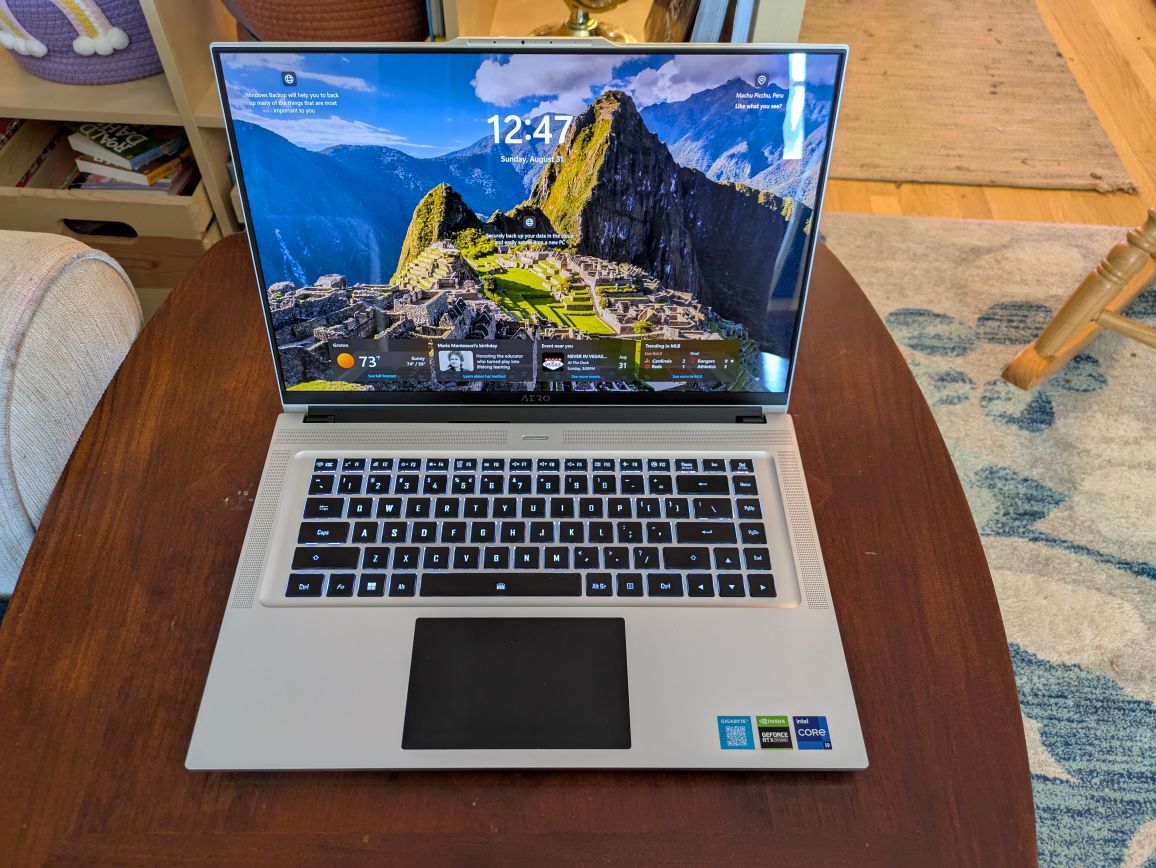
Gigabyte Aero 16 YE5

Mechanical Design Influences Efficiency

The purpose of this article series is to find out just how well laptops do for scientific compute workloads in Folding@Home, the distributed computing project aimed at disease research. Specifically, I’m testing out the hypothesis that laptop hardware and tuning is inherently more energy efficient. The laptop form factor demands that the hardware inside produce less heat than an ATX desktop form factor, because the laptop’s mass and available cooling airflow is significantly less than that of a desktop. By design, a laptop should be more efficient than a desktop. Without being optimized for efficiency, laptops would suffer from extreme heat, poor battery life, reduced battery health, and lack of sales (no one wants to buy a machine that burns your legs and doesn’t last).

This Gigabyte Aero 16 is from 2022, so it’s about two generations behind the bleeding edge, but still relevant. This was a high-end laptop when it was released, and it had the price tag to prove it (MSRP of $4800 as configured). For those of you who have been following along, you know that I tend to review and benchmark slightly older hardware, because it can be obtained at a much more reasonable used price ($1300 on eBay in this case). The performance tuning and optimizations are largely the same, so for the purposes of demonstrating Folding@Home on a laptop, I expect these results to be just as relevant as if I were using a brand new machine.

Here are the specs

Gigabyte Aero 16 YE5 (2022) Specs

CPU: Intel Core I9 12900H, 14 cores (6 Performance, 8 Efficient), 20 threads

Memory: 32 GB DDR5 4800 MHz

GPU0: NVidia RTX 3080 TI, 16GB

GPU1: Intel Integrated Iris Xe

Storate: 2 x 1 TB NVME SSD

Display: Samsung 4K OLED HDR 60Hz

What is a Productivity Laptop, Anyway?

Gigabyte markets the Aero series of laptops as prosumer “Productivity Laptops”, although the specifications would suggest these machines can game very well. I found that to be true (I’m playing Clair Obscur: Expedition 33 with max settings with almost no lag). The difference between productivity laptops such as the Aero and gaming laptops like the Asus Rog Strix is in the chassis design, the aesthetics, and the power profiles. Gaming laptops have that flashy RGB lighting, deeper chassis allowing for more cooling, higher power limits, and faster displays (60 Hz is considered pretty slow for a gaming monitor by today’s standards). The Gigabyte Aero 16 YE5, by comparison, is sleek, relatively thin (despite the big GPU), and sports a gorgeous but sluggish 4K display that content creators drool over thanks to its color accuracy.

One thing that caught my eye about the Aero 16 is the thrifty 105 watt built in GPU power limit for the beastly Nvidia RTX 3080 Ti. This is a monster of a mobile GPU, and most manufacturers who stick this in a laptop are targeting the top-tier gaming market. The typical TDP of the 3080 Ti (mobile) is between 115 and 150 watts, with some laptop manufacturers pushing it to 175 watts and more. This is a far cry from the desktop card’s 350 watt power dissipation, but it’s still a ton of power that must be dissipated as heat that would challenge most laptops.

In the case of Gigabyte, the 105 watt power limit (hardcoded in the vbios) means this laptop is not going to win the ultimate FPS contests with the likes of pure gaming machines. However, that isn’t the point. This machine was designed for content creators who want to be able to load high-poly models for beautiful rendering, or perhaps digital artists who’d like to cram Stable Diffusion 3.5 or Flux models entirely into the video card’s 16 GB of onboard memory.

If you’ve been following along on this blog, you know that for distributed computing projects such as Folding@Home, the maximum efficiency (most science done per watt of power) is typically achieved by down-clocking and/or undervolting the hardware to reduce the power consumption while preserving the majority of performance. Thus, it’s my hope that this specific laptop will set an energy efficiency record on this blog. If it does, it won’t be because of raw performance, but rather its carefully considered design for efficiency.

Nvidia 3080 Ti (mobile) GPU: Not quite the same thing as a 3080

Before continuing, it’s important to note that Nvidia’s mobile implementation of the 3080 Ti is not at all the same thing as a desktop 3080 Ti. For detailed specs, you can read about the card here: https://www.techpowerup.com/gpu-specs/geforce-rtx-3080-ti-mobile.c3840

Notable differences between the laptop GPU and the desktop 3080 Ti are the number of CUDA cores (7424 vs 10240), the memory bus (256 GB vs 384 bit ), and the overall base / boost clock rates (810 / 1260 MHz vs 1365 / 1665 MHz). The desktop 3080 Ti is noticeably more powerful (and thirstier). Since I don’t have a full-sized 3080 Ti, the main point of comparison in this article will be against my 3080 (non-Ti), which has a more similar number of CUDA cores (8704) to the 3080 Ti mobile. See the table below for a detailed breakdown
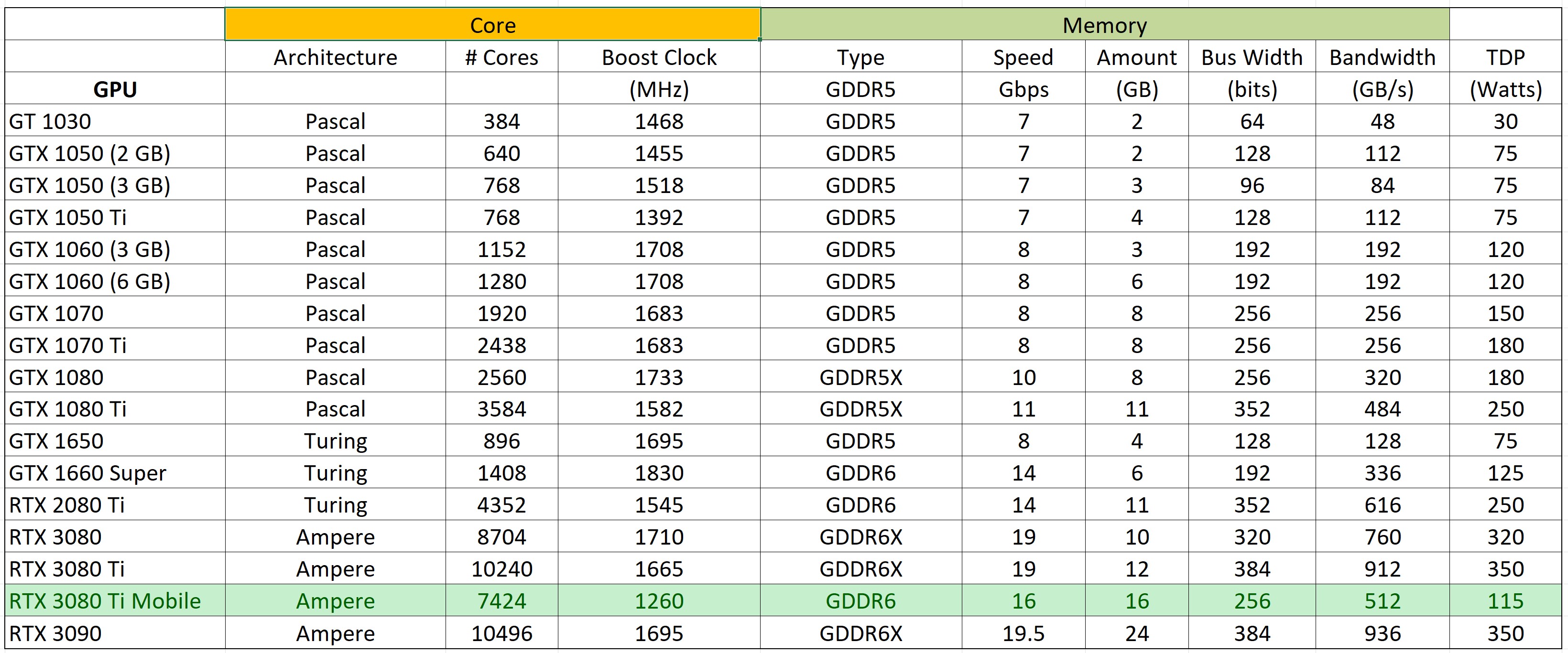
From eyeballing this chart, it’s possible to compute a rough PPD estimate of the 3080 Ti mobile compared to the desktop 3080 (which has a known PPD of about 7 million). To do this, we will derate the desktop 3080’s score by an approximate scaling ratio of GPU performance. This is possible to do since the 3080 and 3080 Ti mobile are both based on Nvidia’s Ampere architecture.

Scaling Ratio = [# CUDA Cores (3080 Ti Mobile) / # CUDA Cores (3080)] x [Boost Clock (3080 Ti Mobile)/Boost Clock (3080)]

Busting out the trusty calculator (BarelyCalc Credit: A. Colon):
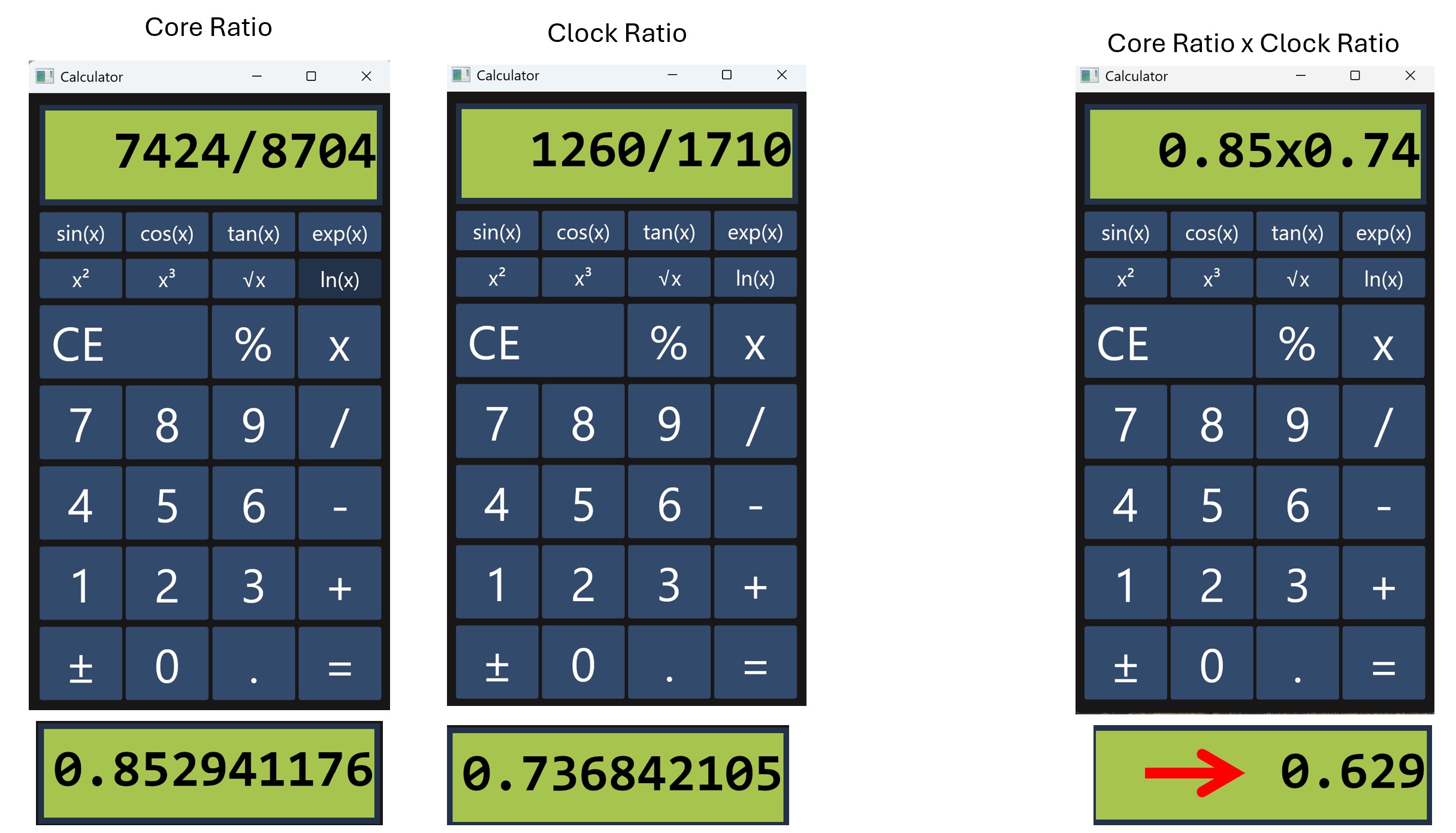
And scaling down the desktop 3080’s 7 million by 0.629 yields an estimated 3080 Ti mobile GPU performance of 4.4 million PPD.

Laptop Cooling–> Make sure you do it

For this test, I’m going to start with the laptop on a hard surface just to get a feel for the machine’s native cooling ability. The hard surface below the computer ensures the air intakes on the bottom have plenty of airflow. For short-term gaming and Folding@Home, this should provide adequate cooling. I expect the system to thermally throttle to keep itself cool. If anyone were to seriously consider using a laptop for long-term high-performance computing, a dedicated laptop cooler beneath the machine is highly recommended for the longevity of the device. For this test, I will be slipping my budget laptop cooler under the machine for the duration of benchmarking.

See the images below for the specific heatsink and cooling configuration on this Gigabyte. The bottom vents are generous (but not oversized as in some gaming laptops), and the twin fans provide cooling from both sides. This machine sucks in cool air from below and blows it out the sides and the back.
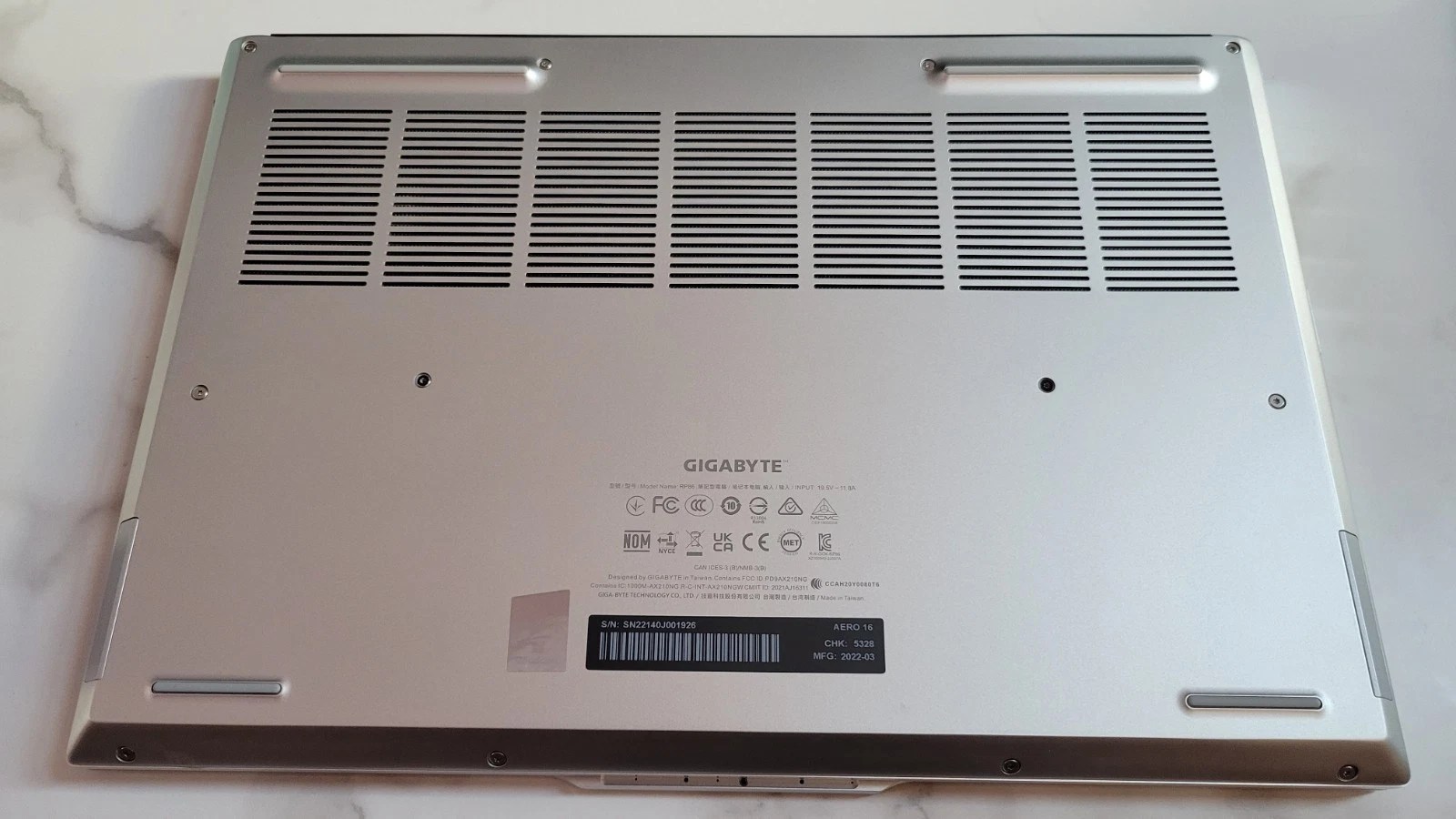
Aero 16 Underside (Photo Credit: Ebay User Ceo.Tech)

Here is what’s beneath the cover. Note the dual cooling fans and heat pipes:
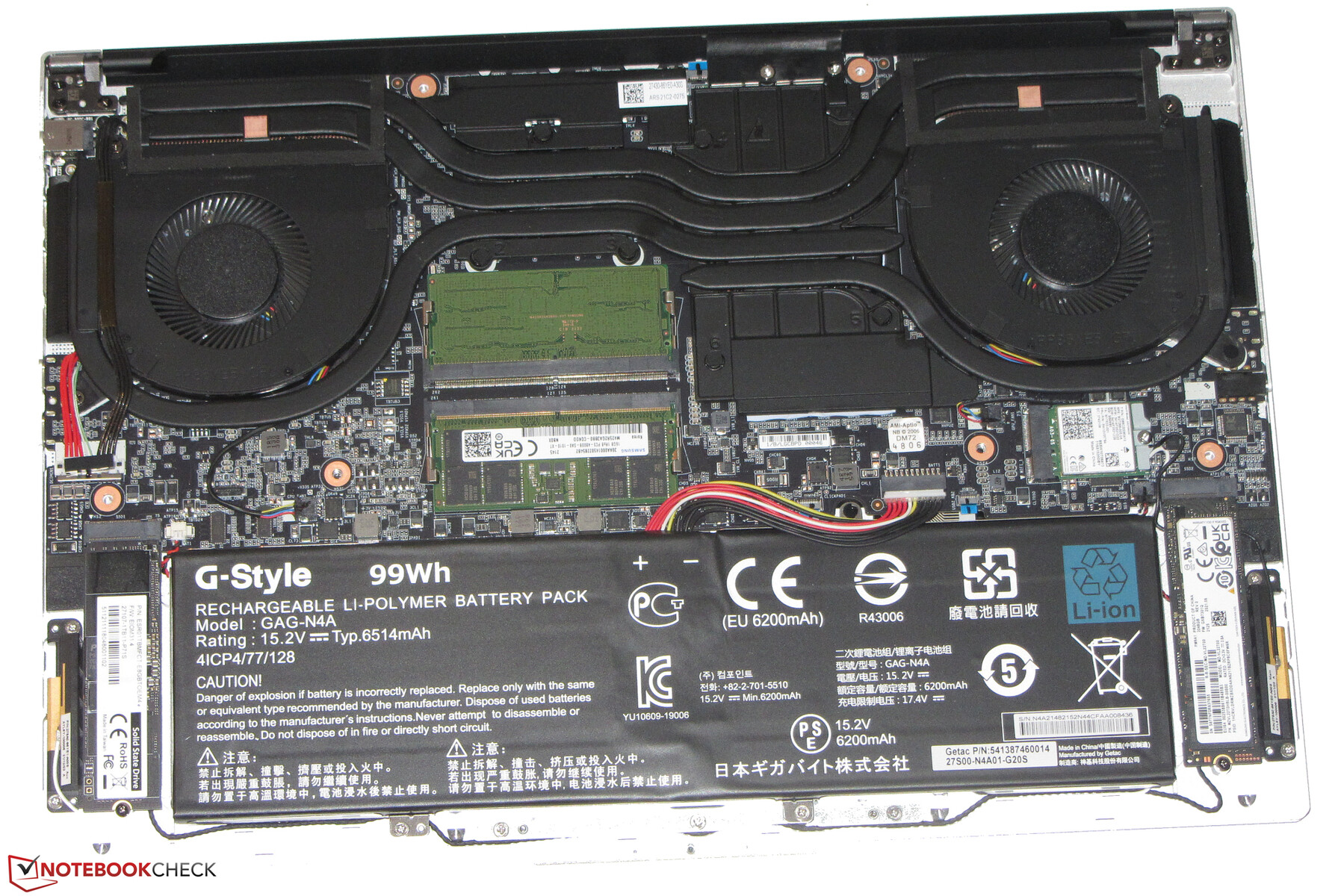
Credit for the inside shot goes to NoteBook Check! Please read their detailed review of the Aero 16, if interested, here: https://www.notebookcheck.net/Gigabyte-Aero-16-YE5-Review-Compact-4K-Multimedia-Notebook.610111.0.html

The Software Environment

I’ll be running this Folding@Home test in Windows 11 using the F@H client 8.4.9 on the GPU. This software is newer than what I’ve run in the past on my benchmark desktop, so the GPU performance plots won’t be an apples-to-apples comparison. But then again, it’s a bakeoff between a desktop and a laptop so…it’s more like a pineapples and grapes comparison.

The Metrics

As with all my previous articles, we’ll be using my trusty P3 Kill-A-Watt meter to measure power at the wall (laptop battery fully charged before testing so there should be no battery charging happening). Folding@Home performance is measured in Points Per Day (PPD). By measuring the system power consumption at the wall, we can compute the energy efficiency of this setup (PPD/Watt).

Pre-Test: Initial Configuration & Cooling

I downloaded the Folding@Home client here and configured one GPU slot for folding. Folding@Home, Google Chrome (for the client web app) and MSI Afterburner are going to be the only programs running during the test.
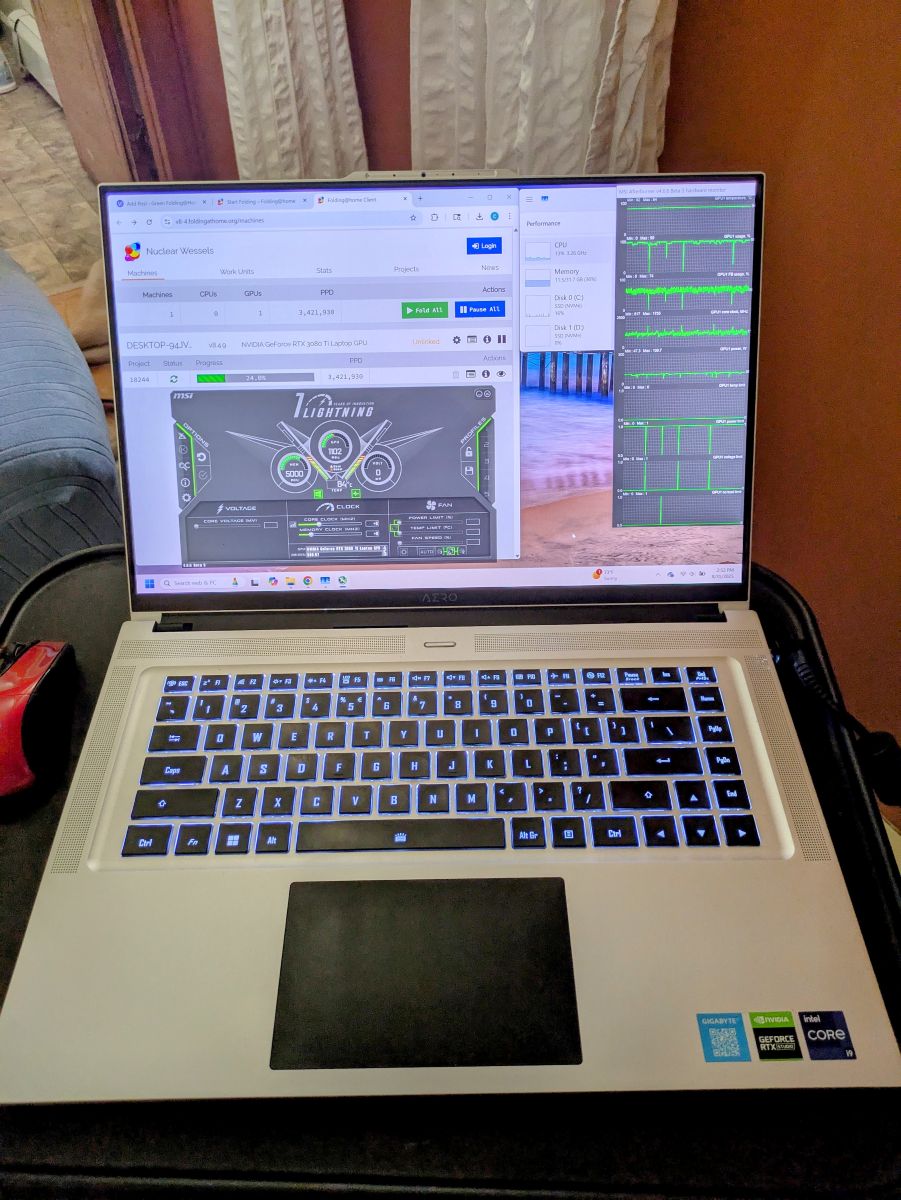
Below is the first work unit this machine has ever folded!
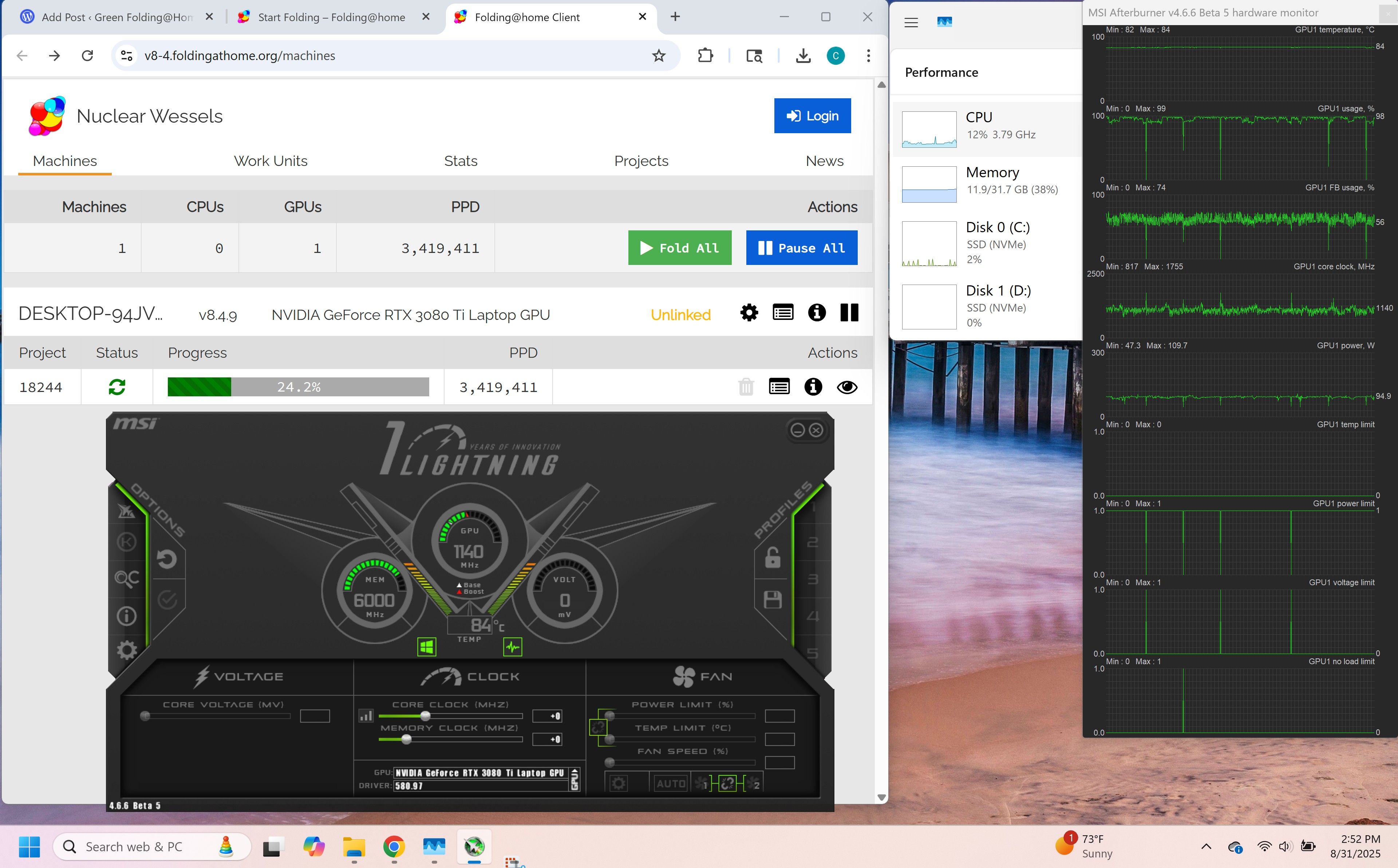
The initial work unit is estimating a 3.4 million PPD performance, which is a bit lower than the 4.4 million PPD I was estimating based on my experience with desktop 30xx-series GPUs. This could also be due to the fact that the Quick Return Bonus portion of the original Stanford University PPD score is exponential, not linear. It’s not worth worring over, as this is still an awesome score for a laptop. I didn’t have the watt meter hooked up (boo on me), but just roughing this out with a guess at total system power consumption of 100 watts results in an efficiency of 34K PPD/Watt! If that’s true, it’s a record for this blog! Part 2 of this article will thorougly investigate and optimize this performance.

There should be some room for signifigant optimization. I noticed the GPU core clocks are hovering right around 1100 MHz, so the machine isn’t hitting its full core boost clock rate. The GPU is pulling down about 95 watts, so slightly below the design’s advertised 105 watt TDP under the Windows default power profile. According to MSI Afterburner, the system is hitting the power limit, and is not actually thermally throttling (much to my surprise). The laptop is very hot to the touch, which means the aluminum case is doing its job dissipating the heat. The fans are kicked up to maximum, and I can tell this thing is begging for more cool air. GPU temps rose quickly and held steady at 84 degrees C. Let’s check out some thermals:
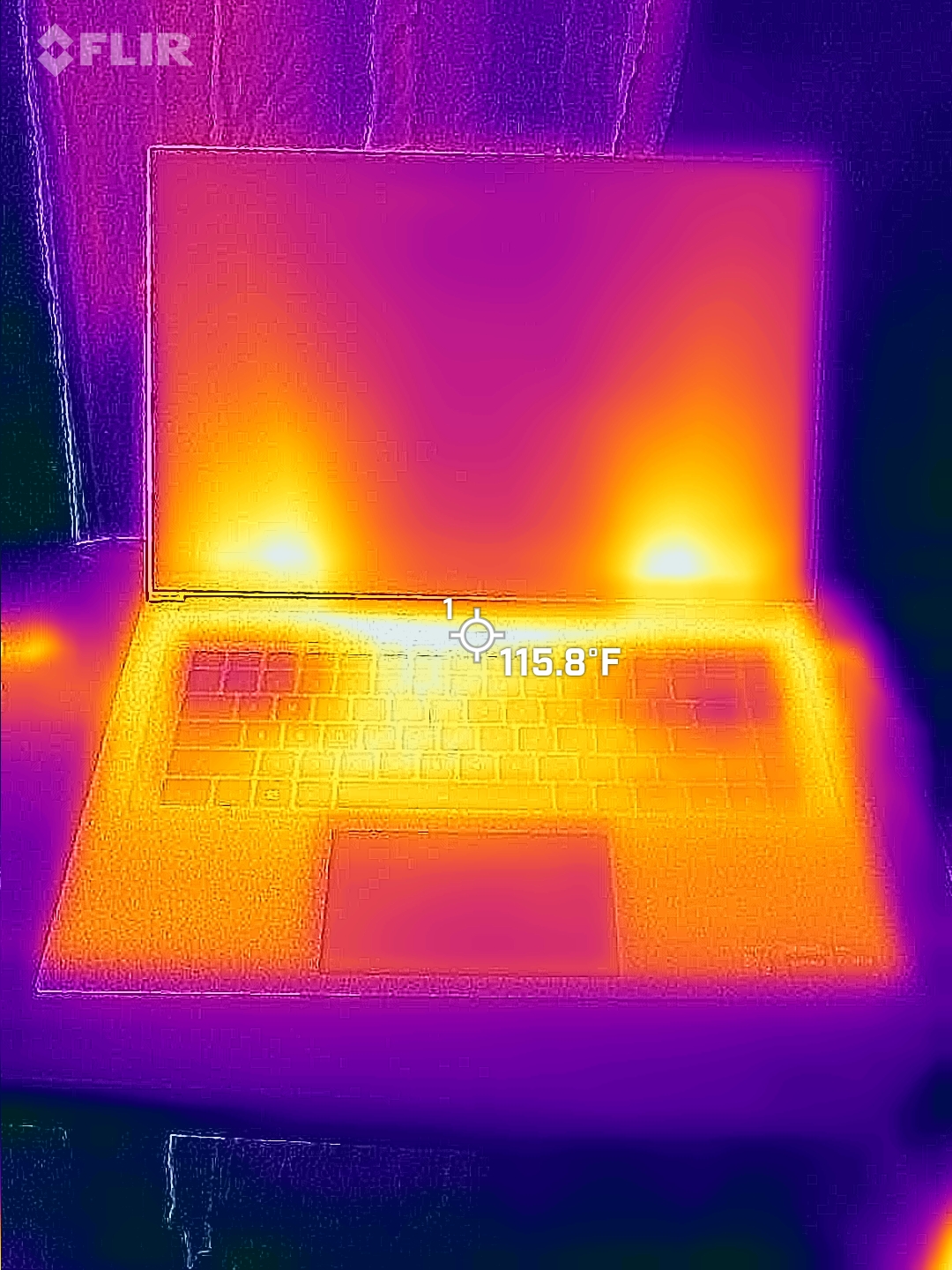
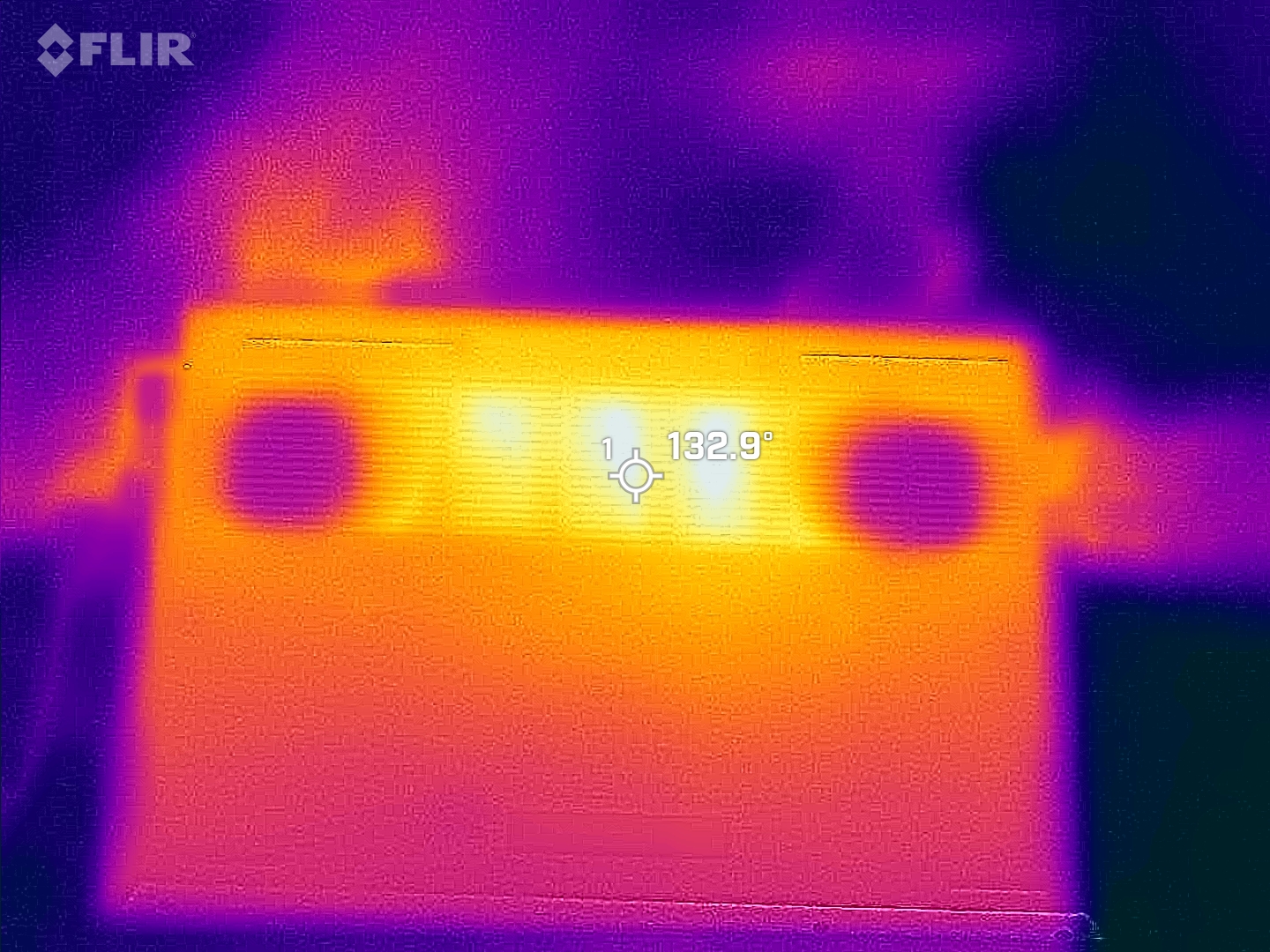
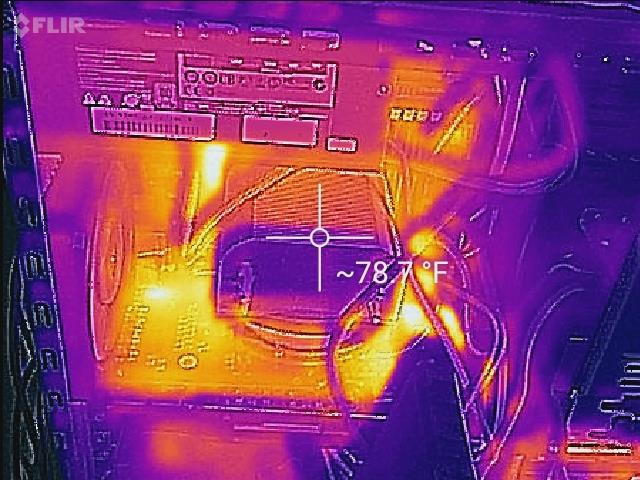
Note: My FLIR camera was set to report temps in Fahrenheit (sorry for mixing temperature units!). With a 115 degree F keyboard bezel and a 132 degree F bottom panel, this is one toasty laptop. In case anyone thinks this is a good thing, let me be clear: it’s too darn hot! High Performance Computing is a very not-normal use case for a laptop, and this result isn’t surprising. I’m not faulting Gigabyte at all. Based on these images and the fact that the laptop was too hot to hold, I’ll be breaking out the laptop cooler.

Laptop Cooler

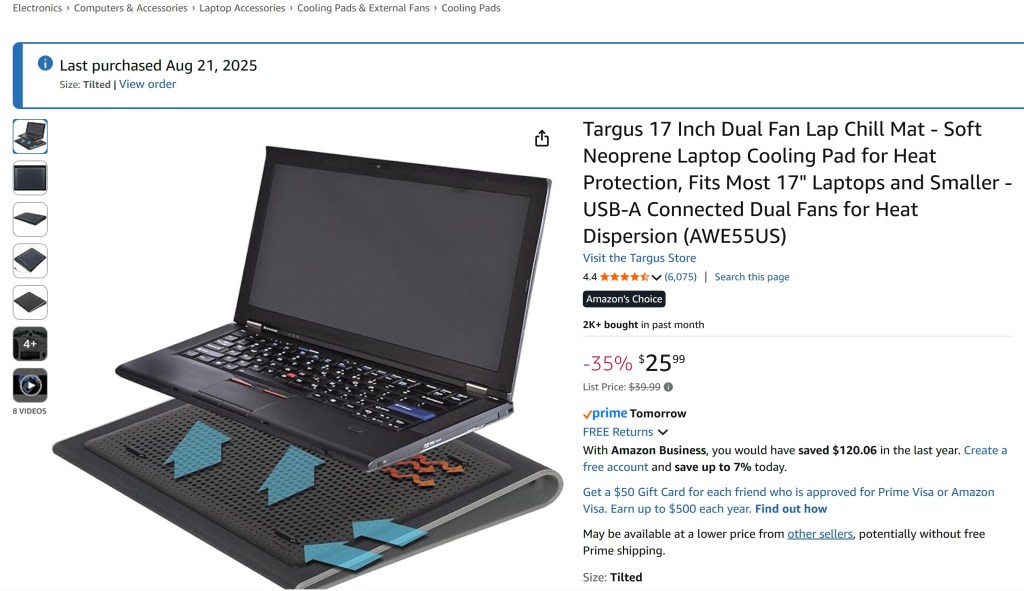
My laptop cooler is nothing special. For $25, this Targus model puts two small fans right under the air intakes on the bottom of the laptop. It’s a no-frills setup, but it has worked well for me for gaming by keeping the computer up off the bed sheets (the archnemesis of all laptop fan intakes). I was surprised with just how well this cooler did. After plugging it in (power coming from USB), the temperatures dropped from 84C to 71C, and the laptop’s fans became much quieter. The machine was still very warm to the touch though, and there wasn’t much of a change on the external radiating surface case temperatures. Still, based on that internal temp drop, I felt much more comfortable about doing some extended testing.
Side-Note: I did the cooling upgrade in the middle of the first work unit. You can see from the MSI afterburner plot that the overall FB Usage on the GPU (corresponding to memory load) became much less hashy after the temps came down, which may indicate more stable operation. Also, there was a very slight but noticeable uptrend in overall GPU clock rate. The estimated PPD as reported by the F@H client increased by 100,000 PPD. This is a small positive change (3%), which suggests there might be some benefit for GPU clock frequencies by reducing the temps, but this result isn’t statistically valid. Many more data points would be needed, using final PPD numbers and not the client’s estimated instantaneous performance, to understand the effect of the laptop cooler on F@H production. Future long-term testing of Folding on laptops with and without an external laptop cooler may be needed (but I don’t want to break my new toy so I won’t be doing much without the laptop cooler)
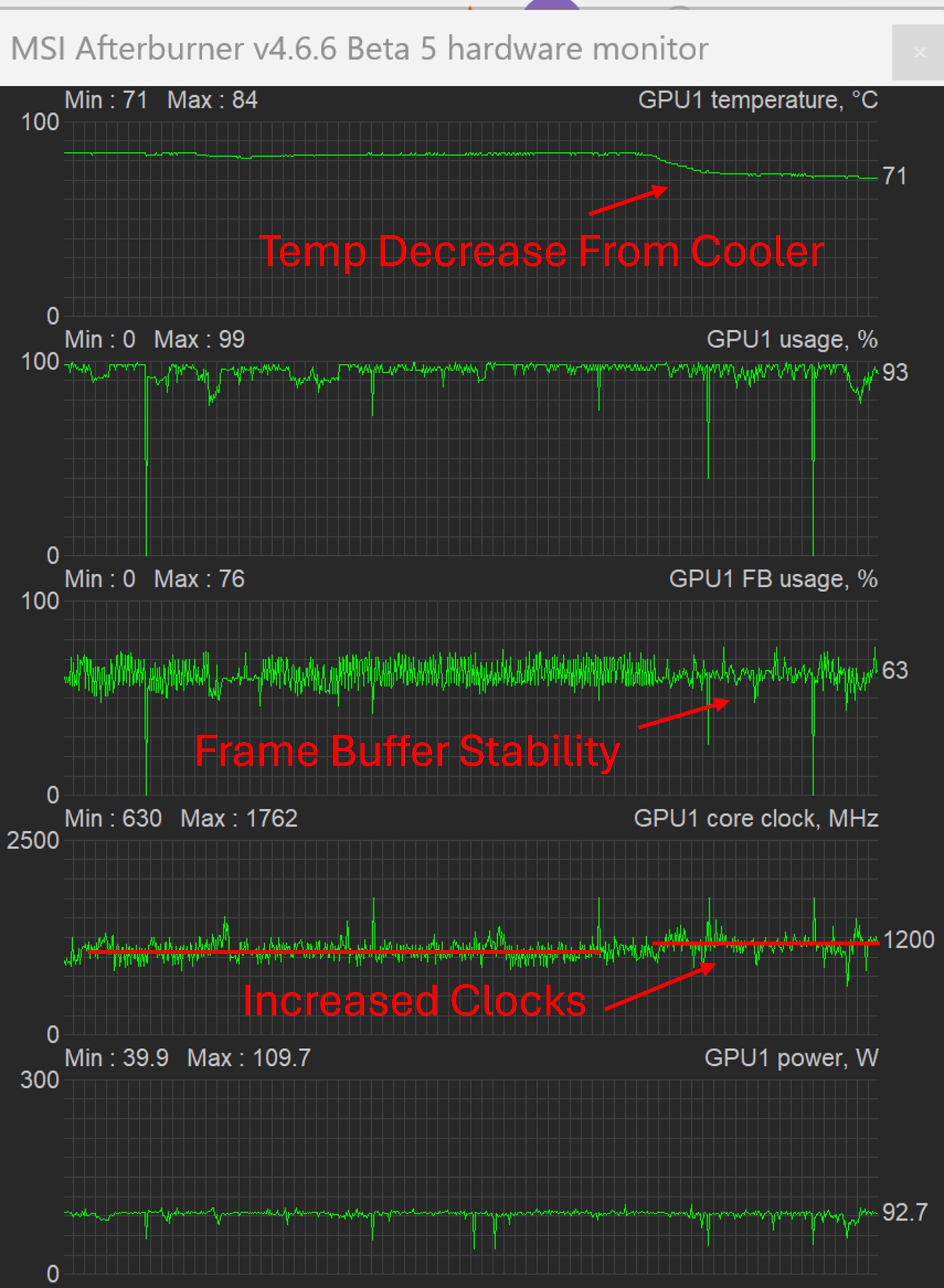
Effect of Laptop Cooler on GPU Temp, FB, and Clock Frequency during Folding@Home

Test Methodology

For this test, I’m going to run a whole bunch of workunits to get a statistically meaningful result, since Folding@Home has significant variation in PPD from one workunit to the next. In order to get a feel for how changing the GPU’s power allocation affects the results, I’m going to use Gigabyte’s Control Center to control the laptop’s power settings. This offers a more direct way than relying on Windows’ built-in power plans, although it’s not really any easier to decipher. Unfortunately, the power limit on the GPU (my main way of adjusting F@H performance and efficiency) is not adjustable in MSI Afterburner in this machine, most likely due to a locked vbios. Power consumption will be at the system level (wall power), measured by eye from the watt meter. Since this tends to jump around a bit, readings that are +/- 5 watts are essentially considered the same wattage.

Here is a screenshot of the Gigabyte Control Center. The relevant power options are boxed in red.
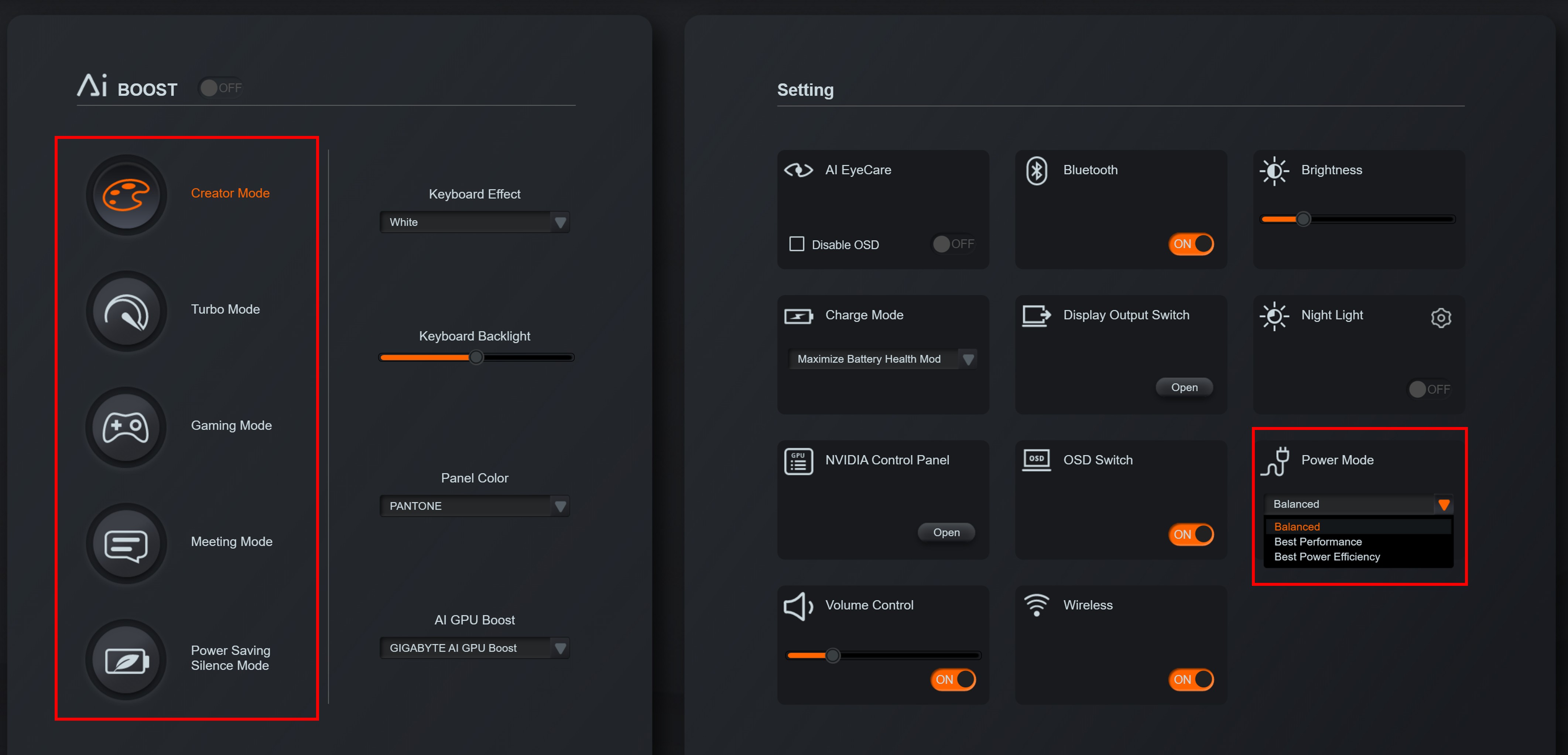
Gigabyte Control Center

Shown on the left-hand side are five power modes for the laptop. They are “Creator Mode”, “Turbo Mode”, “Gaming Mode”, “Meeting Mode”, and “Power Saving Silence Mode”. For each power mode, there are three corresponding drop-downs under the “Power Mode” box (Balanced, Best Performance, and Best Power Efficiency”. It’s super annoying that Gigabyte named these things the same. Do the power modes on the right modify the power modes on the left? Do they override them? The documentation is not very clear.

After playing around with these settings, I found very that the “big” power modes on the left do noticably change the GPU power consumption (as reported in MSI Afterburner). For example, when in “Gaming” or “Turbo” mode, the GPU would hit up to 105-110 watts (compared to the Windows Default of 95 watts). When set to Creator mode, it would hover between 80 and 90 watts. Meeting Mode and Power Saving mode further reduced the GPU to about 80 watts continuous.

Frustratingly, the effect of the power mode drop-downs was less evident.

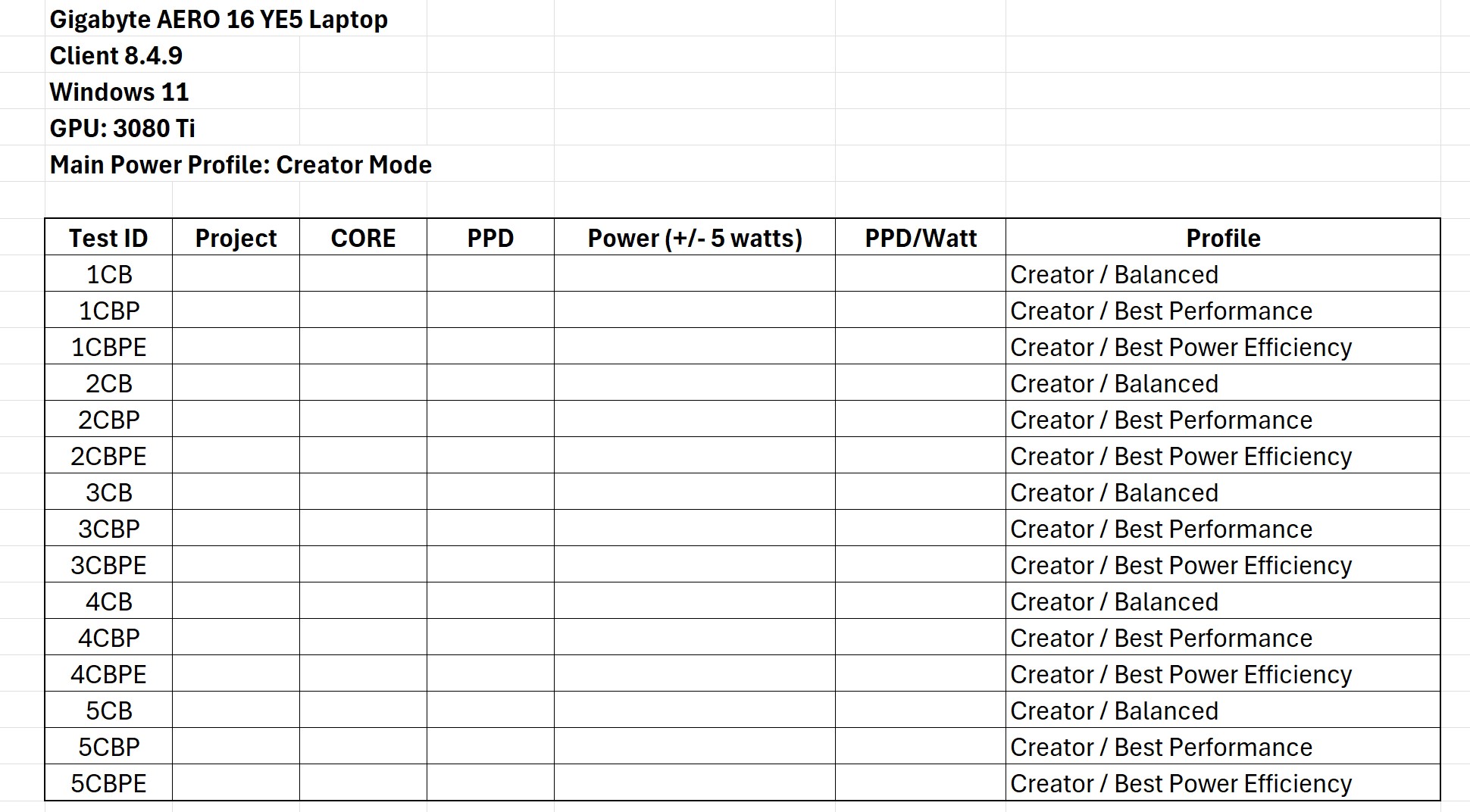
To sort all this out, I’m going to primarily focus on the five major power modes on the left side of the control panel, since those seemed to actually do something. I’m going to run five work units under each power mode and record the instantaneous PPD and Wattage at the midpoint of each run, as shown in the client. Within each work unit, I will also vary the “little” power mode setting at three discrete points during the solve and record the results. This will determine if the little modes do anything.

Overall, this will produce 5 x 5 x 3 = 75 data points, which should be enough to draw some general conclusions about this laptop and hopefully enough to determine the best settings for energy efficiency on this machine. Longer-term testing using statistics reported to the Folding@Home collections server will be done to verify the most efficient setting.

Here is an example of the test matrix that will be used to capture data for each setting:
Alright, I’ve got the machine up and running and a test plan. Now all we need to do is camp out and take some data. This will take some time (probably a week or two). Stay tuned for Part II of this article (Test Results)!
RTX 3080 Folding@Home Mini-Review

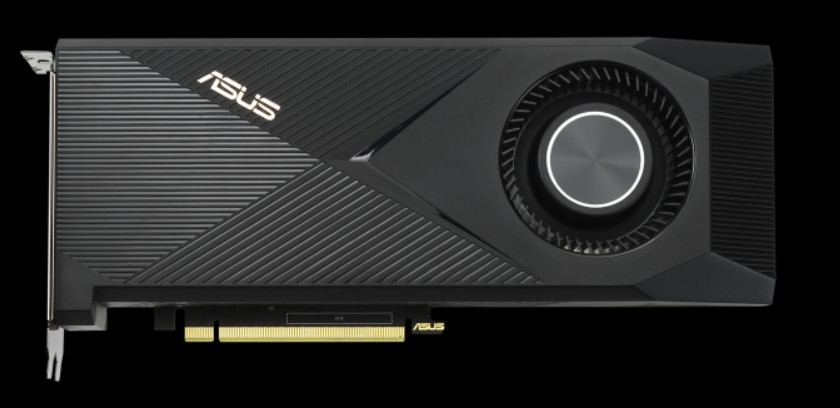
Hey everyone! It’s been a while since I’ve written a new article, mostly because of welcoming two new members to the family over the past two years (a 4th kid + a dog!). However, I haven’t been completely inactive. I sold my 3090 and picked up a much slimmer ASUS RTX 3080 (yes, it’s a blower model! I love my blower cards).

Asus NVidia RTX 3080 LHR

This card is a workhorse! I’ve been using it to game in 1440P and run diffusion model image generation. Although it doesn’t have nearly as many CUDA cores or as much memory as the 3090, this card still handles everything I throw at it. I expect it would struggle a bit with 4K gaming on ultra settings, but my gaming days are long behind me so I’m happy as can be.

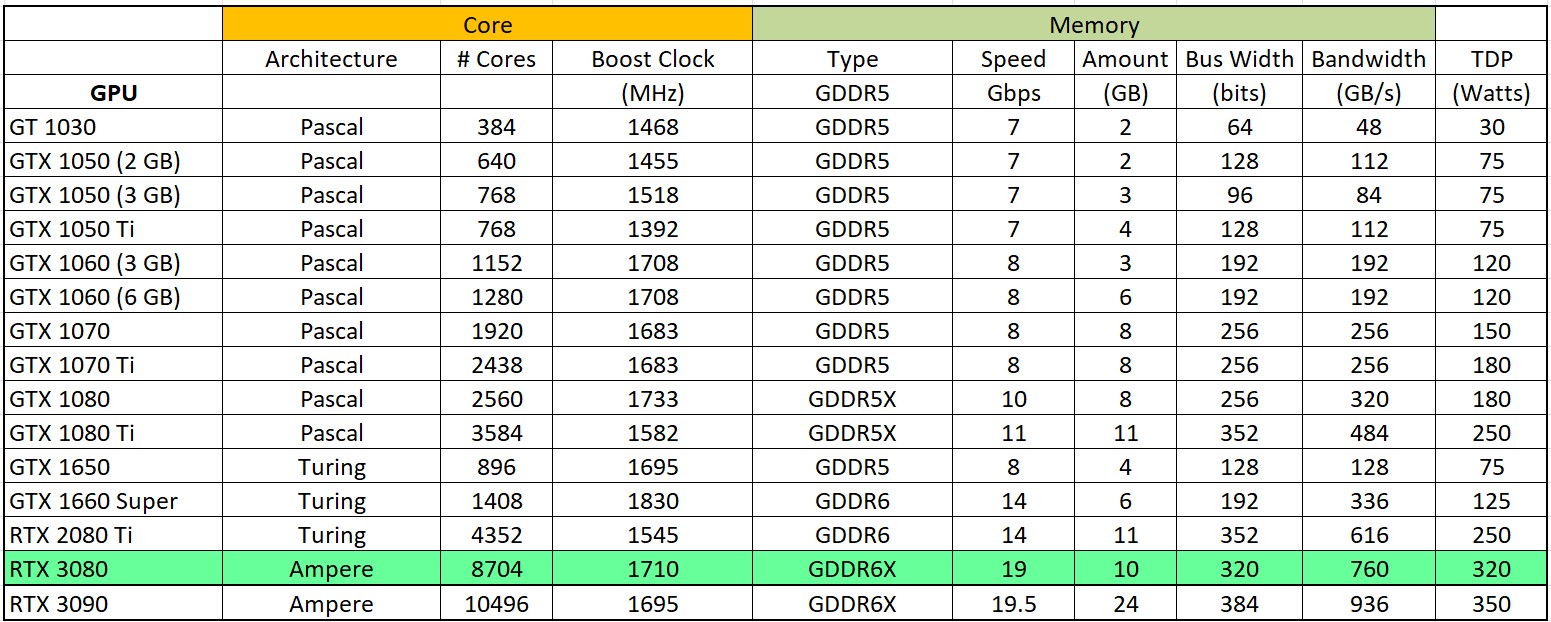
Anyway, I thought I’d throw together a short review before moving on to more modern GPUs. Here is how the 3080 stacks up compared to the rest of the NVidia lineup I’ve tested so far:

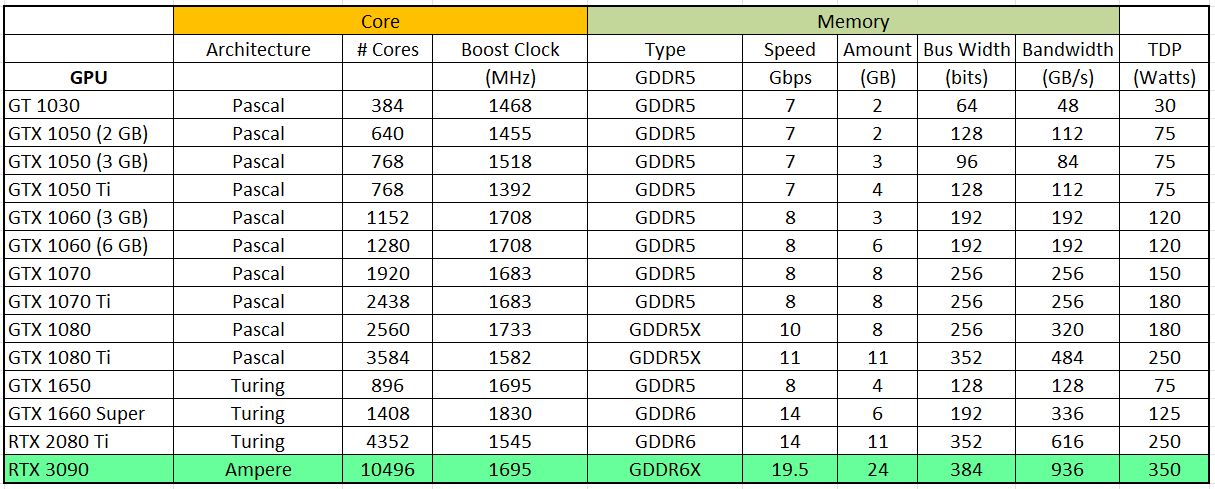
NVidia RTX 3080 Stats

From eyeballing this chart, it appears the 3080 should be significantly slower than the 3090 in compute workloads, since it has over 1000 fewer CUDA cores and less than half the memory. However, as we’ve seen before, for the majority of molecular dynamics models, there is a point of diminishing returns after which a single model simply cannot fully exercise the massive amount of hardware available to it.

I used my AMD R9 3950X-based benchmark desktop, which admittedly is getting a little long in the tooth at 5 years old (remember all those COVID incentive check PC builds!). The point is, the hardware is consistent except for the graphics card being tested, and I’m pretty sure the monstrous 16-core flagship Ryzen 9 3950X is still more than capable of feeding Folding@Home models to modern graphics cards. All power measurements were taken with my trusty P3 Kill A Watt meter at the wall (grab one on Amazon here if you want. I don’t get anything from this link…it’s just a nice watt meter and you should definitely own one or five!)

I used the Folding@Home Version 7.6.13 Client running in Windows 10 (although I am now on 11 as I type this, so perhaps there is a Win10 vs 11 comparison in the future). The card was running in CUDA mode, although I am going to stop noting that on the plots going foreword unless I specifically run a card with and without CUDA processing enabled in the F@H client.

Side-Note: The card shows up as the “LHR” model in the vBIOS. This stands for “Lite Hash Rate”. This is a now-obsolete limiter on the card’s mining hash rate to make it less appealing to cryptocurrency miners, and has minimal effect on Folding@Home performance according to various sources.

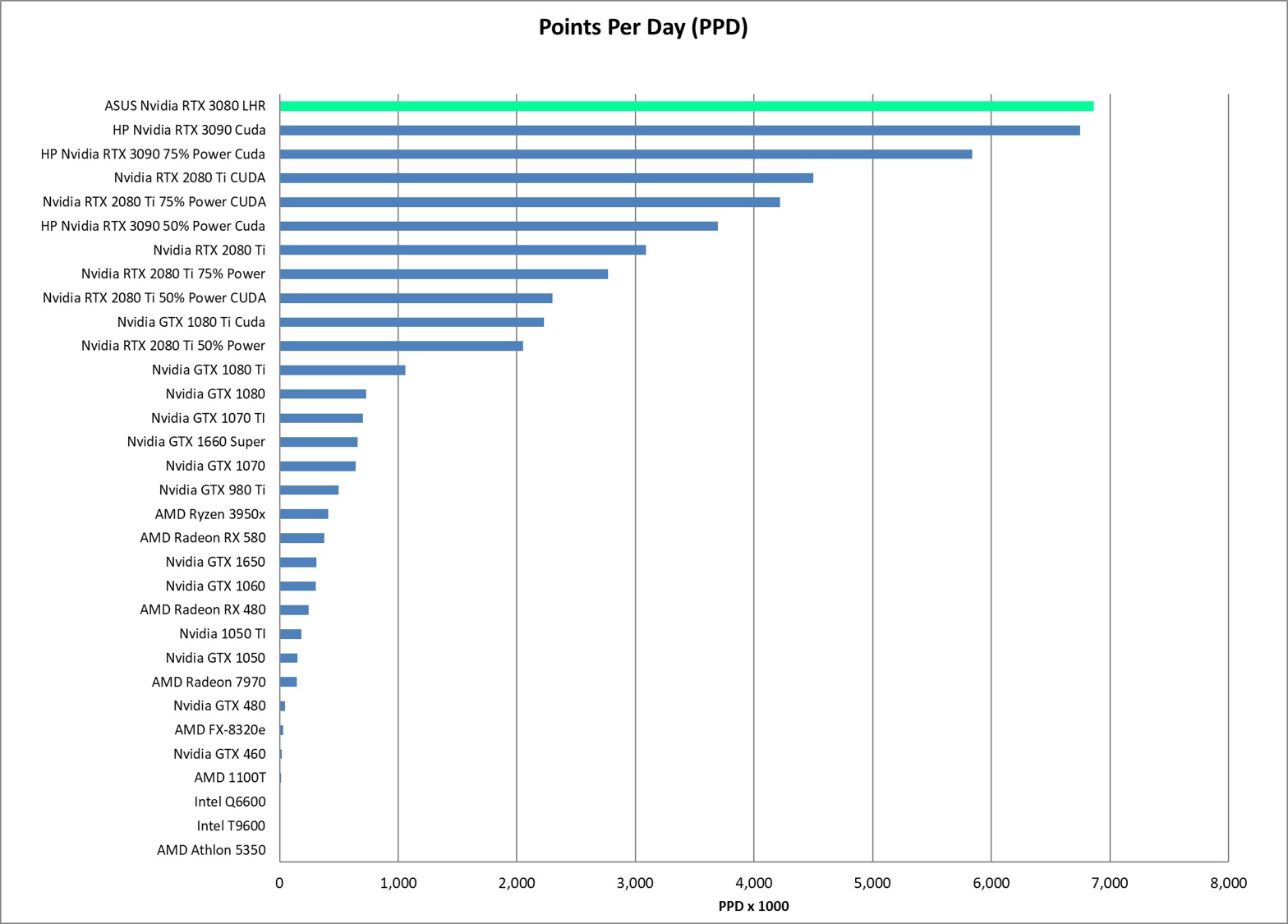
Since this is a short review, I will jump right to the Points Per Day (PPD) and Efficiency (PPD/Watt) results. They were surprising, to say the least.

Performance (Points Per Day) and System Wall Power (Watts)

NVidia RTX 3080 LHR PPD
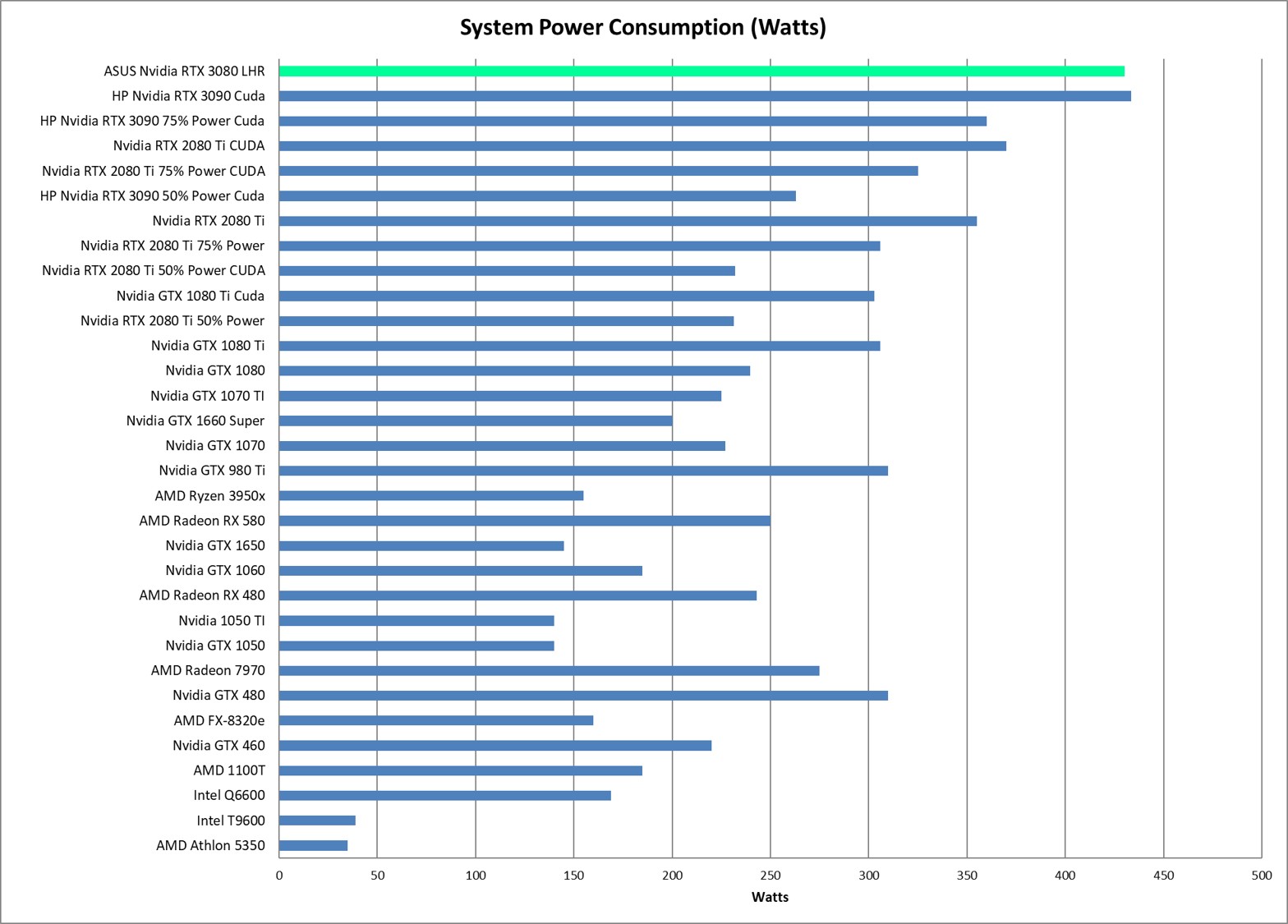
NVidia RTX 3080 LHR Power Consumption

Energy Efficiency (PPD/Watt)

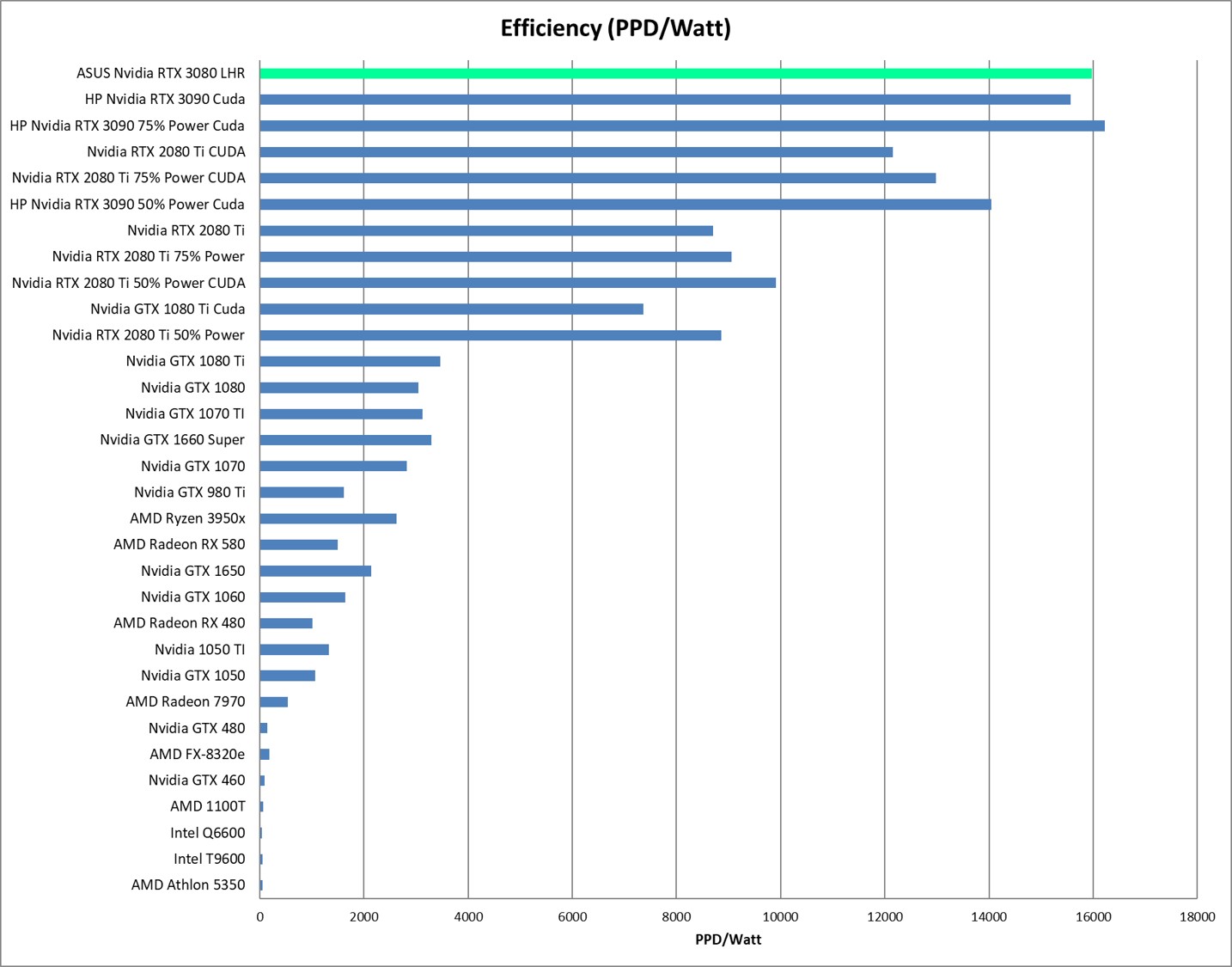
NVidia RTX 3080 LHR Efficiency

Conclusion: RTX 3080 Beats its Big Brother!

The RTX 3080 is a great GPU for compute workloads such as Folding@Home, and actually surpasses the 3090 in terms of raw performance by a small margin (687K PPD vs 675K PPD). Now this is only a 3% difference and thus is well within the normal +/- 10 percent or so variation that we typically see when running the same series of models over and over on an individual graphics card. Thus, I think the more appropriate conclusion is to say that the 3080 and 3090 perform the same on normal-sized models in Folding@Home. I believe the models are simply not large enough at the time of this writing to fully utilize the extra CUDA cores and memory that the 3090 offers. Additionally, the slight improvement in power efficiency comes from the fact that the 3080 draws nominally 30 less watts than the 3090, making it a slightly more efficient card. Only when reducing the power target on the 3090 to 75% was I able to match the out-of-the-box efficiency of the 3090.

So, there you have it. The 3080 continues the trend of its predecessors, started by the noble 1080 TI as one of the best bang-for-the-buck computational graphics cards money can by. If you want to do some cancer-fighting with your computer on the cheap, you can pick up a used 3080 on eBay right now for about $350.

Folding@Home on GeForce RTX 3090 Review

Hi everyone, sorry for the delay in blog posts. Electricity in Connecticut has been so expensive lately that except for our winter heating Folding@Home cluster, it wasn’t affordable to keep running all those GPUs (even with our solar panels, which is really saying something). However, I did manage to get some good data on the top-tier Nvidia RTX 3090, which I got during COVID as the GPU in a prebuilt HP Omen gaming desktop. I transplanted the 3090 into my benchmark desktop, so these stats are comparable to previous cards I’ve tested.

Wait, what are we doing here?

For those just joining, this is a blog about optimizing computers for energy efficiency. I’m running Folding@Home, a distributed computing research project that uses your computer to help fight diseases such as cancer and covid and a host of other ailements. For more information, check out the project website here: https://foldingathome.org/

Look at this bad boy!

This is the HP OEM version of an RTX 3090. I was impressed that it had lots of copper heat pipes and a metal back plate. Overall this was a very solid card for an OEM offering.

HP OEM Nvidia RTX 3090 installed in my AMD Ryzen 9 3950X benchmark desktop

At the time of my testing, the RTX 3090 was the top-tier card from Nvidia’s new Ampere line. They have since released the 3090 Ti, which is ever so slightly faster. To give you an idea of where the RTX 3090 stacks compared to the previous cards I have tested, here is a table. Note that 350 watt TDP! That is a lot of power for this air cooler to dissipate.

The Test

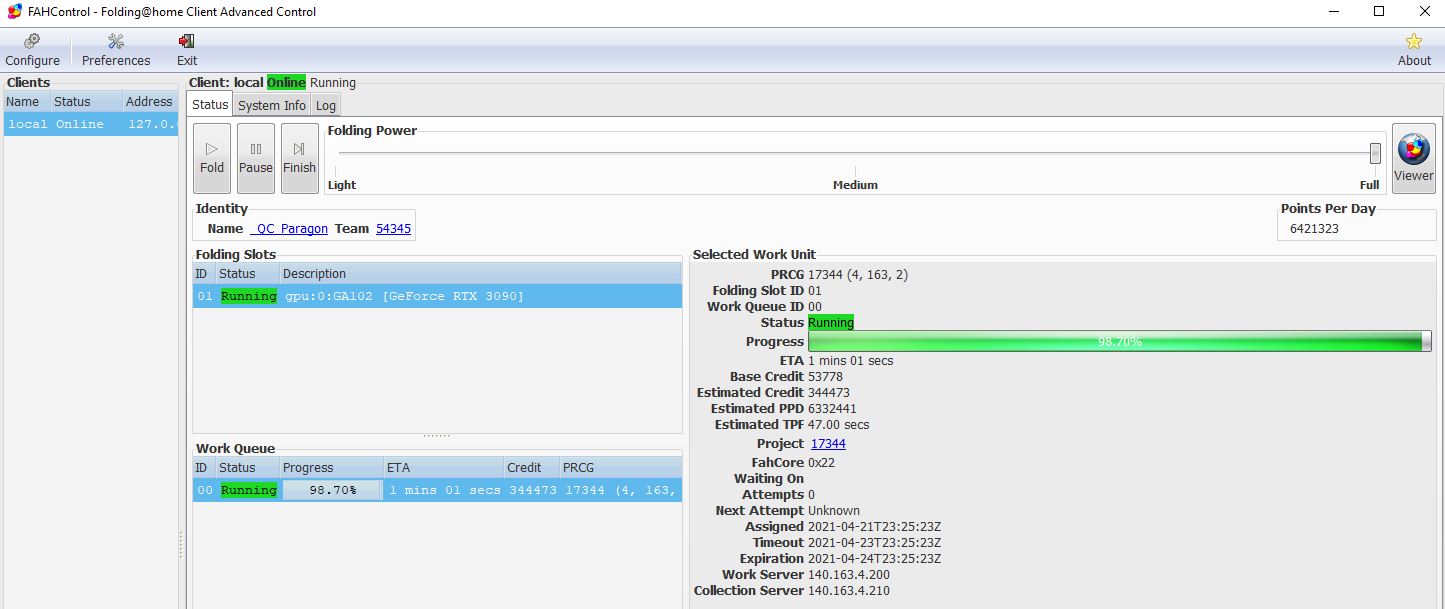
I ran Folding@Home on my benchmark desktop in Windows 10, using Folding@Home client 7.6.13. I was immediately blown away by the insane Points Per Day (PPD) that the 3090 can spit out! Here’s a screen shot of the client, where the card was doing a very impressive 6.4 million PPD!

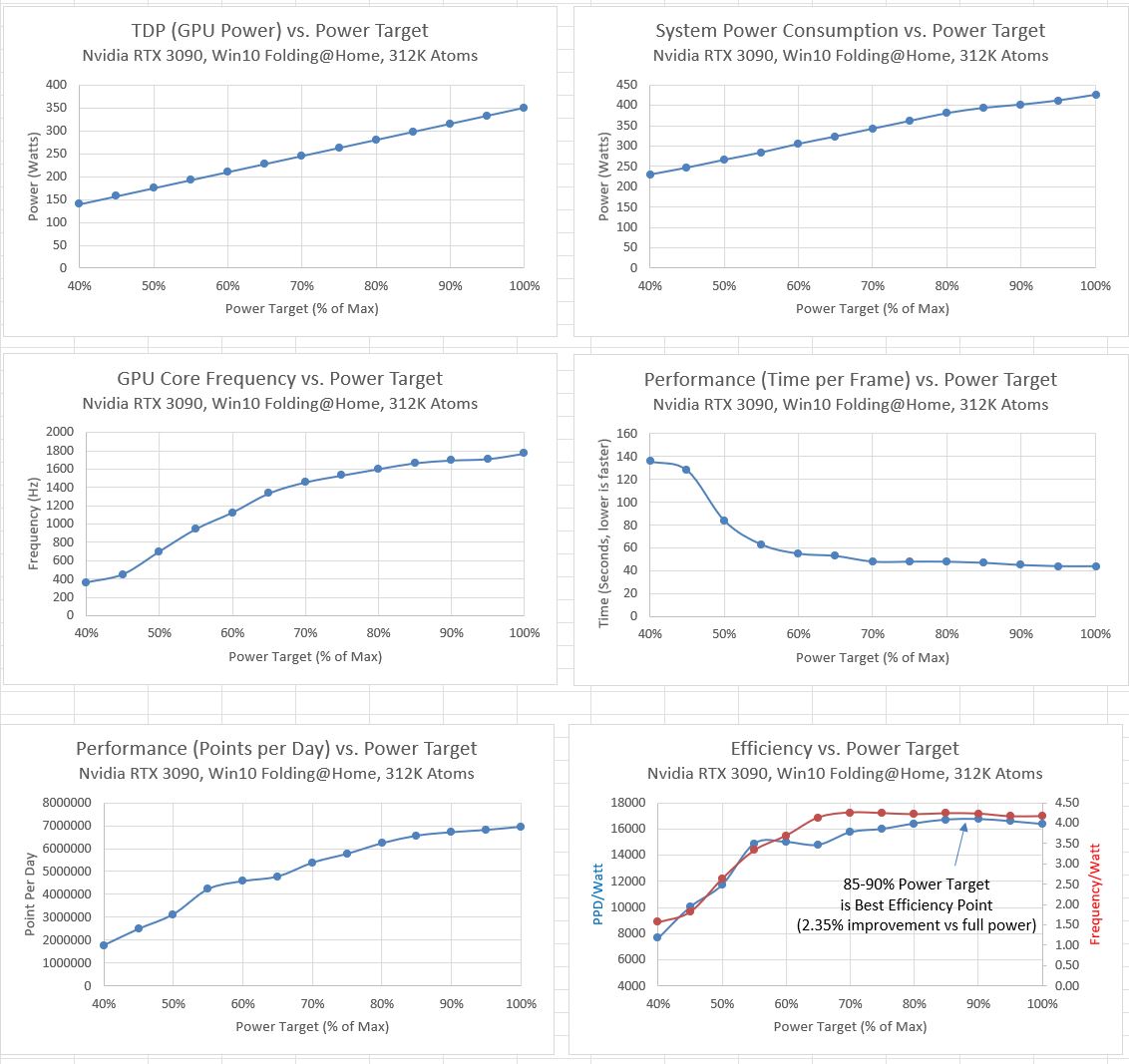
What was really interesting about the 3090 though was how much variation there was in performance depending on the size of the molecule being worked on. Very large molecules with high atom counts benefited greatly from the number of CUDA cores on this card, and it kicked butt in both raw performance (PPD) and effiency (PPD/Watt). Smaller molecules, however, did not fully utilize this card’s impressive potential. This resulted in a less efficiency and more wasted power. I would assume that running two smaller Ampere cards, for example the 3080, with small models would be more efficient than using the 3090 for small models, but I haven’t got any 3080’s to test that assumption (yet!).

In the plots below, you can see that the smaller model (89k atoms) resulted in a peak PPD of about 4 million, as opposed to the 7 million PPD with a 312k atom model. PPD/watt at 100% card power was also less efficient for the smaller model, coming in at about 16,500 PPD/Watt vs. 10,000 PPD/Watt. These are still great efficiency numbers, which shows how far GPU computing has come from previous generations.

Reduce GPU TDP Power Target to Improve Efficiency

I’ve previously shown how GPUs are set up for maximum performance out of the box, which makes sense for video gaming. However, if you are trying to maximize energy efficiency of your computational machines, reducing the power target of the GPU can result in massive efficiency gains. The GeForce RTX 3090 is a great example of this. When solving large models, this beast of a card benefits from throttling the power down, gaining 2.35% improved energy efficiency with a power target set for 85%. However, the huge improvement comes for solving smaller models. When running the 89k atom work unit, I got a whopping 29% efficiency improvement when setting the power target to 55% with only a 14% performance reduction! Since the F@H project gives out a lot of smaller work units in addition to some larger ones, I chose to run my machine at a 75% power target. On average, this splits the difference, and gives a noticeable efficiency improvement without sacrificing raw PPD performance too much. In the RTX 3090’s case, a 75% power target massively reduced the power draw on the computer (reduced wall consumption from 434 to 360 watts), as well as reduced heat and noise coming out of the chassis. This promotes a more happy office environment and a happier computer, that will last longer!

Tuning Results: 89K Atoms (Small Model)

Here are the tuning plots for a smaller molecule. In all cases, the X-axis is the power target, set in the Nvidia Driver. 100% corresponds to 350 Watts in the case of the RTX 3090.

Tuning Results: 312K Atoms (Large Model)

And here are the tuning results for a larger molecule.

Overall Results

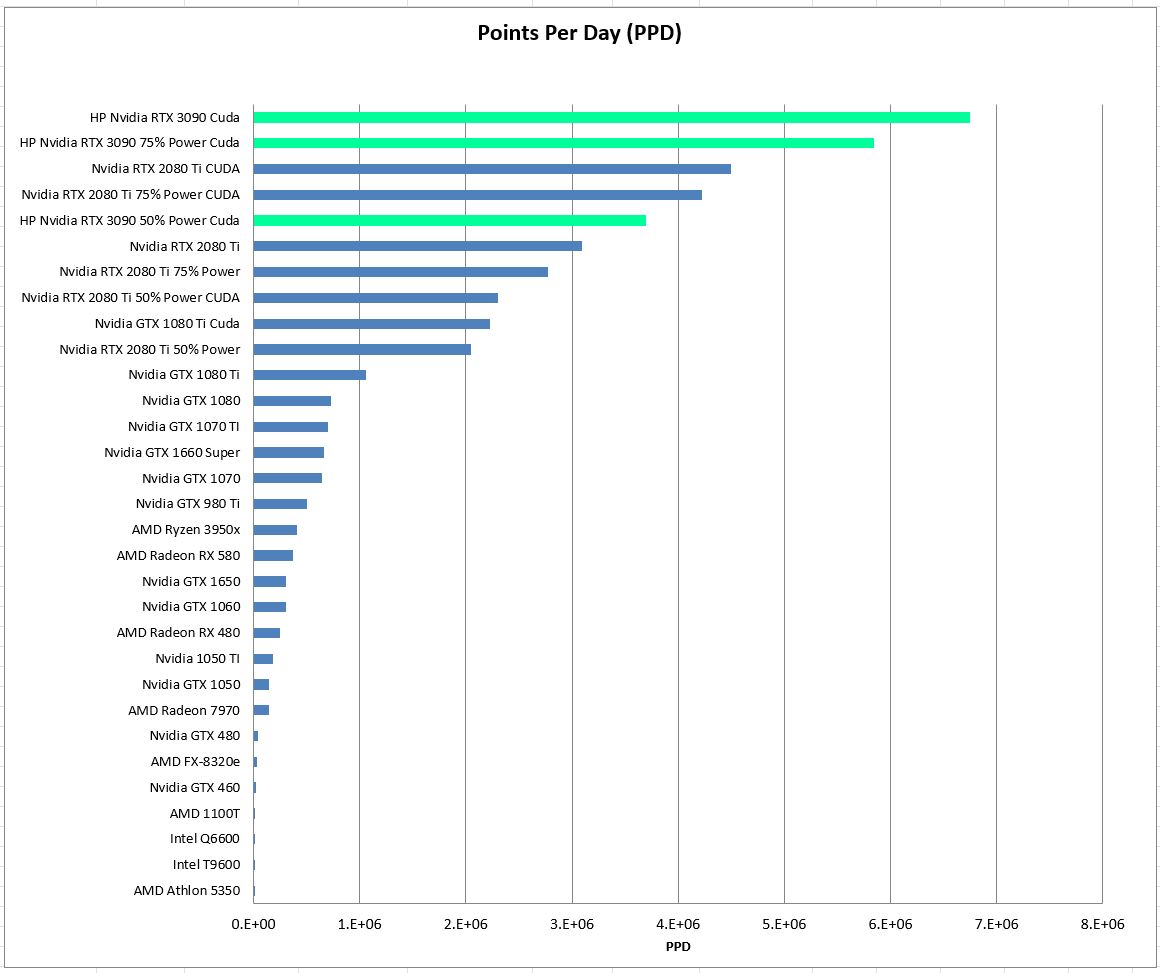
Here are the comparison results to the previous hardware configurations I have tested. Note that now that the F@H client supports enabling CUDA, I did some tests with CUDA on vs. off with the RTX 2080 Ti and the 3090. Pro Tip: MAKE SURE CUDA IS ON! It really speeds things up and also improves energy efficiency.

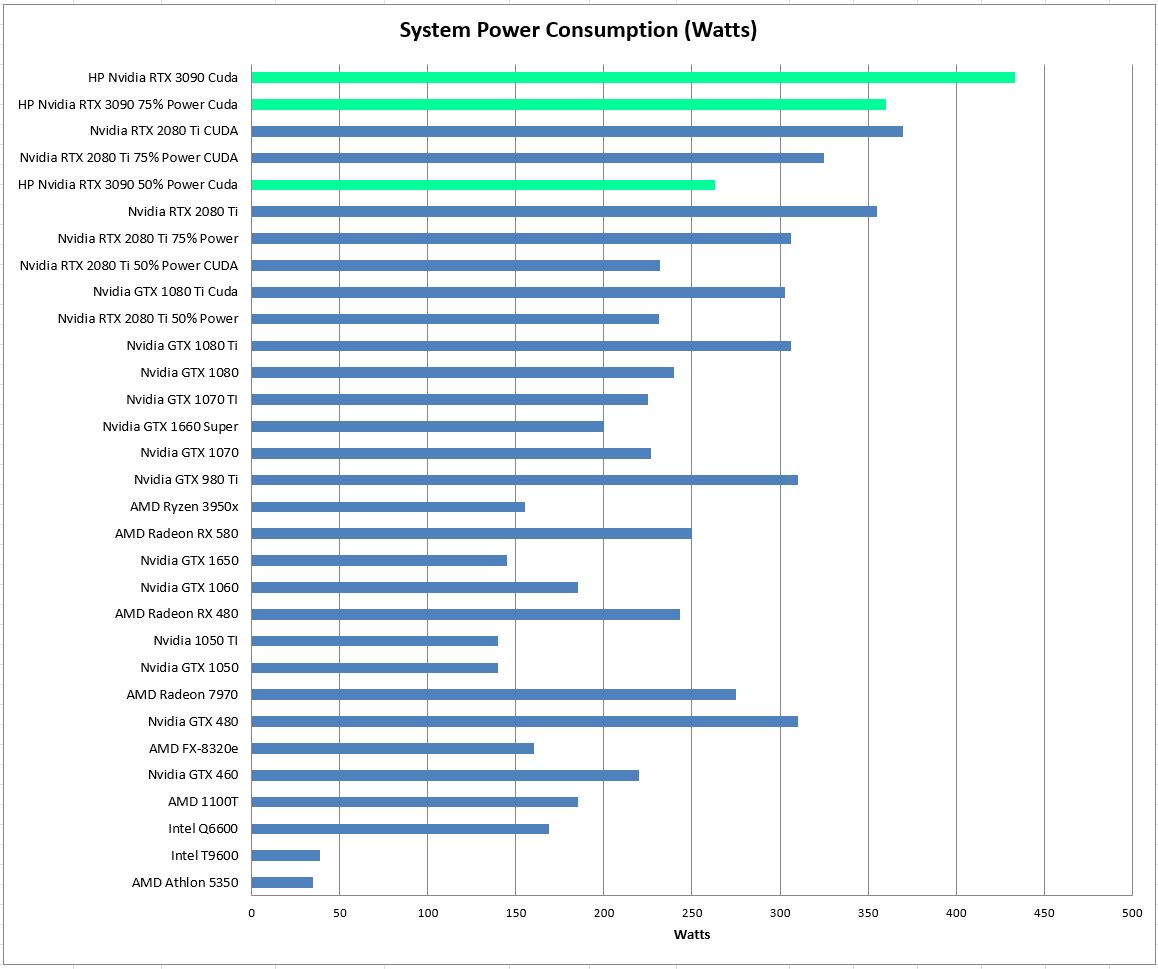
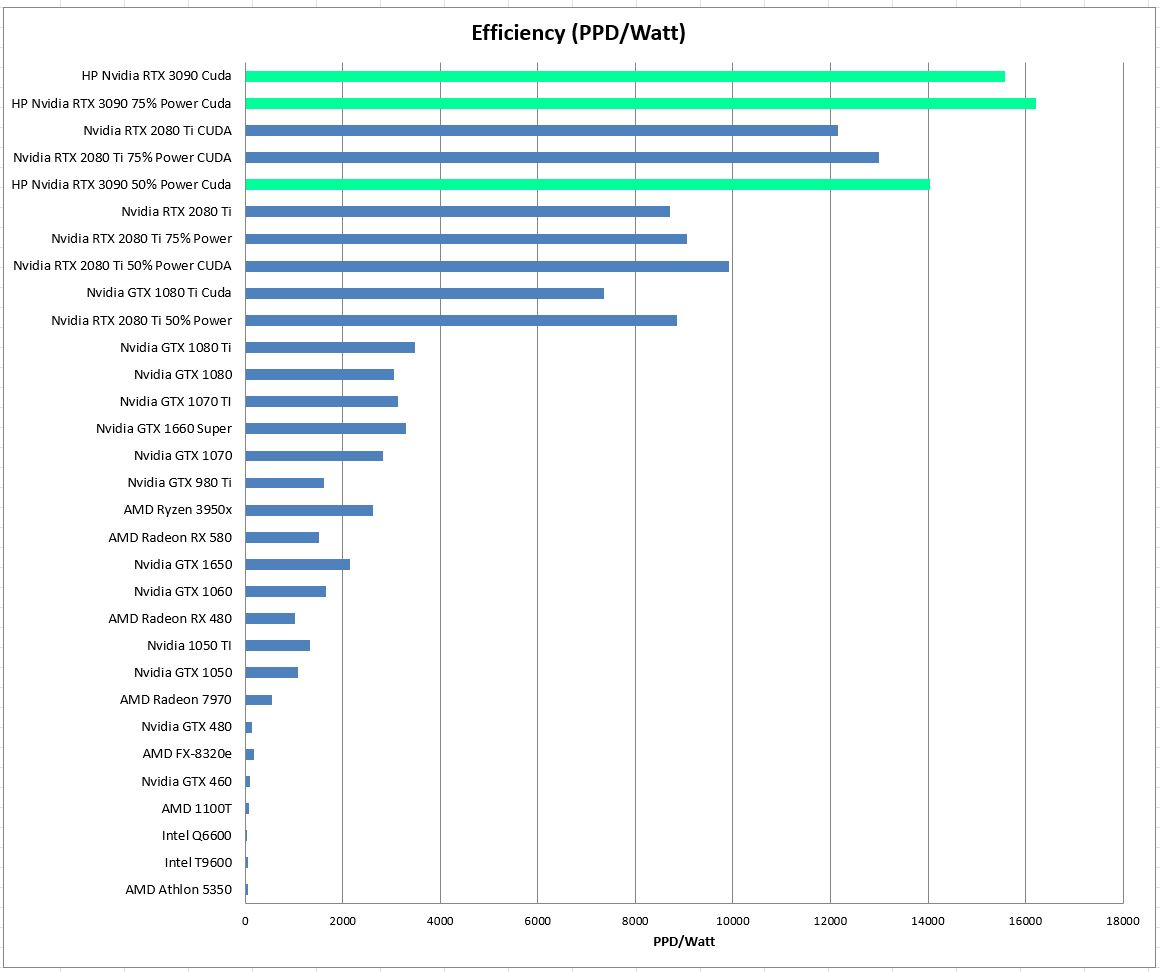
Key takeaways from below is that the 3090 offers 50% more performance (PPD) than the 2080 Ti, and is almost 30% more energy efficient while doing it! Note this does not mean this card sips power…it actually uses more watts than any of the other cards I’ve tested. However, it does a lot more computation with those watts, so it is putting the electricity to better use. Thus, a data center or workstation can get through more work in a shorter amount of time with 3090s vs. other cards, and thus use less power overall to solve a given amount of work. This is better for the environment!

Nvidia RTX 3090 Folding@Home Performance (green bars) compared to other hardware configurations
Nvidia RTX 3090 Folding@Home Total System Power Consumption (green bars) compared to other hardware configurations
Nvidia RTX 3090 Folding@Home Energy Efficiency (green bars) compared to other hardware configurations.

Conclusion

The flagship Ampere architecture Nvidia GeForce RTX 3090 is an excellent card for compute applications. It does draw a ton of power, but this can be mitigated by reducing the power target in the driver to gain efficiency and reduce heat and noise. In the case of Folding@Home disease research, this card is a step change in both performance and energy efficiency, offering 50% more compute power and 30% more efficiency than the previous generation. I look forward to testing out other Ampere cards, as well as the new 40xx “Lovelace” architecture, if Eversource ever drops the electric rate back to normal levels in CT.

AMD Ryzen 9 3950X Folding@Home Review: Part 2: Averaging, Efficiency, and Variation

Welcome back everyone! In my last post, I used my rebuilt benchmark machine to revisit CPU folding on my AMD Ryzen 9 3950x 16-core processor. This article is a follow-on. As promised, this includes the companion power consumption and efficiency plots for thread settings of 1-32 cores. As a quick reminder, I did this test with multi-threading (SMT) on, but with Core Performance Boost disabled, so all cores are running at the base 3.5 GHz setting.

Performance

The Folding@Home distributed computing project has come a long way from its humble disease-fighting beginnings back in 2000. The purpose of this testing is to see just how well the V7 CPU client scales on a modern, high core-count processor. With all the new Folding@Home donors coming onboard to fight COVID, having some insight into how to set up the configuration for the most performance is hopefully helpful.

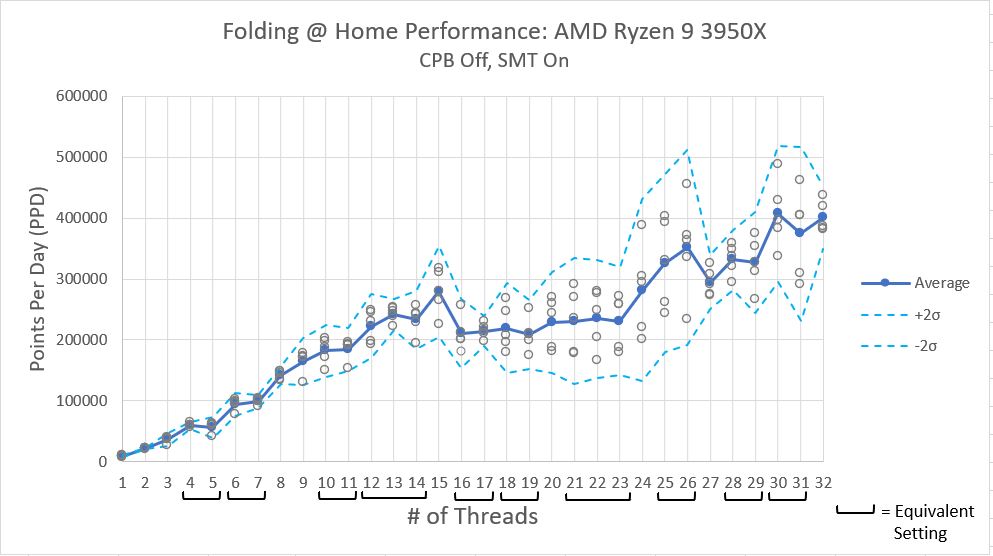
For this test, I simply set the # of threads the client can use to a value and ran five sequential work units. I averaged the performance (Points Per Day), but I also plot the individual work unit performance values to give you a sense of the variation. Since the Ryzen 9 3950x supports 32 threads, I essentially ran 160 tests. Since I wanted the Folding@Home Consortium to get useful data in their fight against COVID-19, I let each work unit run to completion, even though I only need them to run to about 10-20% complete to get an accurate PPD estimate from the client.

So, without further blabbing on my part, here is the graph of Folding@Home performance vs. thread count in Windows 10 on the Ryzen 9 3950x

Ryzen_3950x_Performance_SMT_Off_CPB_On

Here, the solid blue line is the averaged performance, and the gray circles are the individual tests. The dashed blue lines represent a statistical 95% confidence interval, which is computed based on the variation. The expected Points Per Day (PPD) of a work unit run on the 3950x is expected to fall within this band 95% of the time.

My first observation is, holy crap! This is a fast processor. Some work units at high thread counts get really close to 500K PPD, which for me has only been achievable by GPU folding up to this point.

My second observation is that there is a lot of variation between different work units. This makes sense, because some work units have much larger molecules to solve than others. In my testing, I found the average variation of all 160 tests to be 12.78%, with individual variance up to 25%.

My third observation is that there seems to be two different regions on this plot. For the first half, the thread count setting is less than the number of physical cores on the chip, and the results are fairly linear. For the second half, the thread count setting is higher than the number of physical cores on the chip (thus forcing the CPU to virtualize those cores using SMT). Performance seems to fall off when the CPU cores become fully saturated (threads = 16), and it takes a while to climb out of the hole (threads = 24 starts showing some more gains).

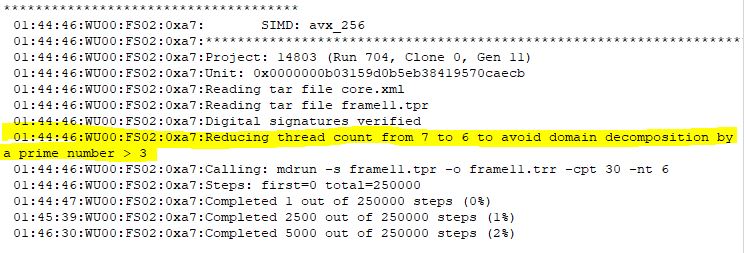
As a side note, the client does not actually run all of these thread count settings, since some prime numbers, especially large primes (7, 11) and multiples thereof cause numerical issues. For example, when you try to run a 7-thread solve, the client automatically backs the thread count down to 6. You can see warnings in the log file about this when it happens.

Prime Number Thread Adjust

I noted all the relevant thread counts where this happens on the x-axis of the plot. Theoretically, these should be equivalent settings. The fact that the average performance varies a bit between them is just due to work unit variation (I’d have to run hundreds of averages to cancel all the variation out).

Finally, I noticed that the highest PPD actually occurred with a thread count of 30 (PPD = 407200) vs a thread count of 32 (PPD = 401485). This is a small but interesting difference, and is within the range of statistical variation. Thus I would say that setting the thread count to 30 vs 32 provides the same performance, while leaving two CPU threads free for other tasks (such as GPU folding…more on that later!).

Power Consumption

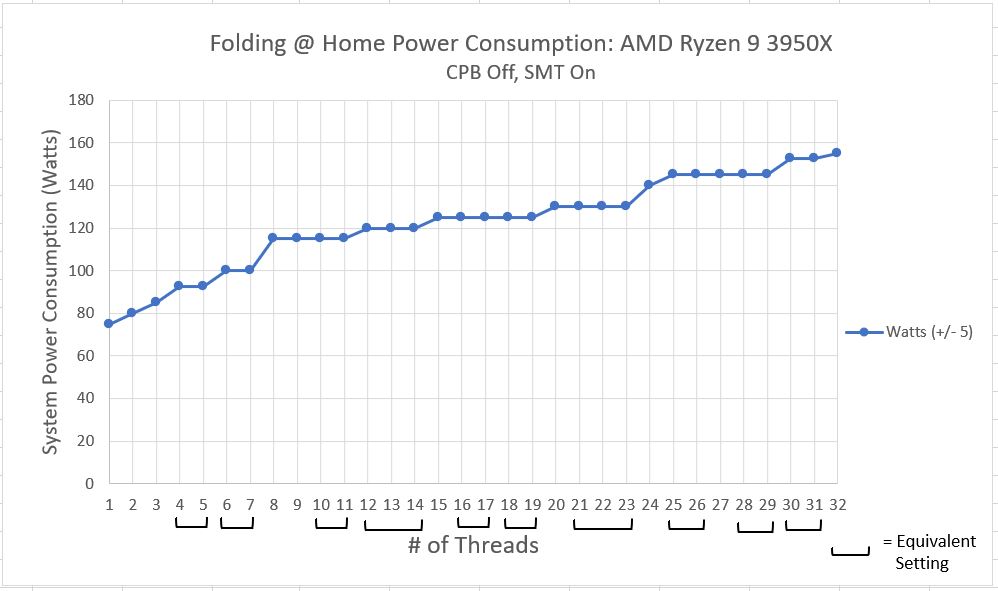
Power consumption numbers for each thread setting were taken at the wall, using my P3 Kill A Watt meter. Since the power numbers tend to walk around a bit as the computer works, it’s hard to get an instantaneous reading. Thus these are “eyeball averaged”. There was enough change at each CPU thread setting to clearly see a difference (not counting those thread settings that are actually equivalent to an adjacent setting).

Ryzen_3950x_Power_SMT_Off_CPB_On

The total measured power consumption rose fairly linearly from just under 80 watts to just under 160 watts. There’s not too much surprising here. As you throw more threads at the CPU, it clocks up idle cores and does more work (which causes more transistors to switch, which thus takes more power). This seems pretty believable to me. At the high end, the system is drawing just under 160 watts of power. The AMD Ryzen 9 3950x is rated at a 105 watt TDP, and with CPB turned off it should be pretty close to this number. My rough back of the hand calculation for this rig was as follows:

  1. CPU Loaded Power = 105 Watts
  2. GPU Idle Power (Nvidia GTX 1650) = 10 Watts
  3. Motherboard Power = 15 Watts
  4. Ram Power = 2 watts * 4 sticks = 8 watts
  5. NVME Power = 2 watts * 2 drives = 4 watts
  6. SSD Power = 2 watts

Total Estimated Watts @ F@H CPU Load = 144 Watts

Factor in a boat load of case fans, some silly LED lights, and a bit of PSU efficiency hit (about 90% efficient for my Seasonic unit) and it’ll be close to the 160 watts as measured.

Efficiency

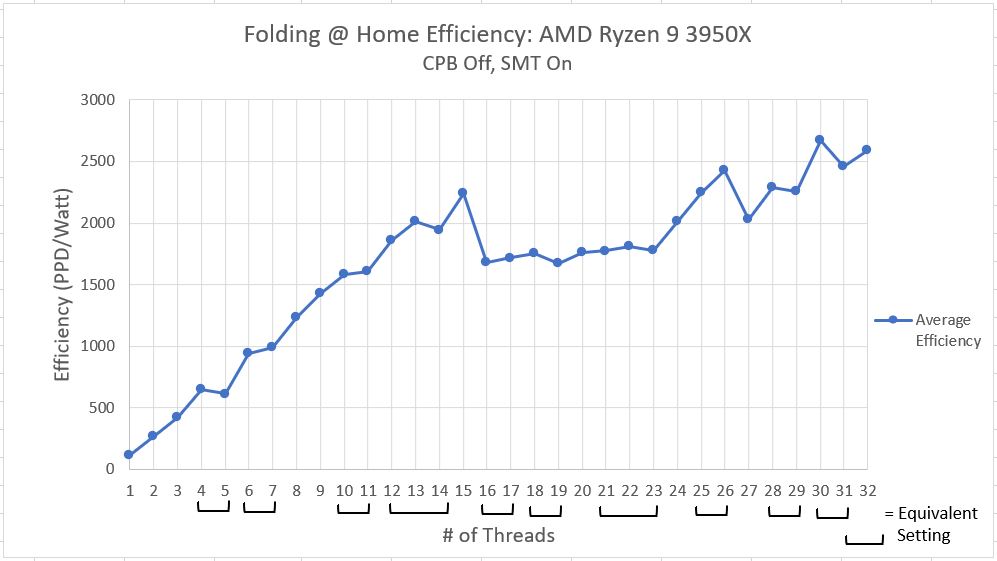
This being a blog about saving the planet while still doing science with computers, I am very interested in energy efficiency. For Folding@Home, this means at doing the most work (PPD) for the least amount of power (watts). So, this plot is just PPD/Watts. Easy!

Similar to the PPD plot, this efficiency plot averages five data points for each thread setting. I chose to leave off the individual points and the confidence interval, because that looks about the same on this plot as it does on the PPD plot, and leaving all the clutter off makes this easier to read.

Ryzen_3950x_Efficiency_SMT_Off_CPB_On

As with the PPD plot, there seem to be two regions on the efficiency curve. The first region (threads less than 16) shows a pretty good linear ramp-up in efficiency as more threads are added. The second region (threads 16 or greater) is what I’m calling the “core saturation” region. Here, there are more threads than physical cores, and efficiency stays relatively flat. It actually drops off at 16 cores (similar to the PPD plot), and doesn’t start improving again until 24 or more threads are allocated to the solver.

This plot, at first glance, suggests that the maximum efficiency is realized at # of threads = 30. However, it should be noted that work unit variation still has a lot of influence, even with reporting results of a 5-sample average. You can see this effect by looking at the efficiency drop at threads = 31. Theoretically, the efficiency should be the same at threads = 31 and threads = 30, because the solver runs a 30-thread solution even when set to 31 to prevent domain decomposition.

Thus, similar to the PPD plot, I’d say the max efficiency is effectively achieved at thread counts of 30 and 32. My personal opinion is that you might as well run with # of threads = 30 (leaving two threads free for other tasks). This setting results in the maximum PPD as well.

Weird Results at Threads = 16-23

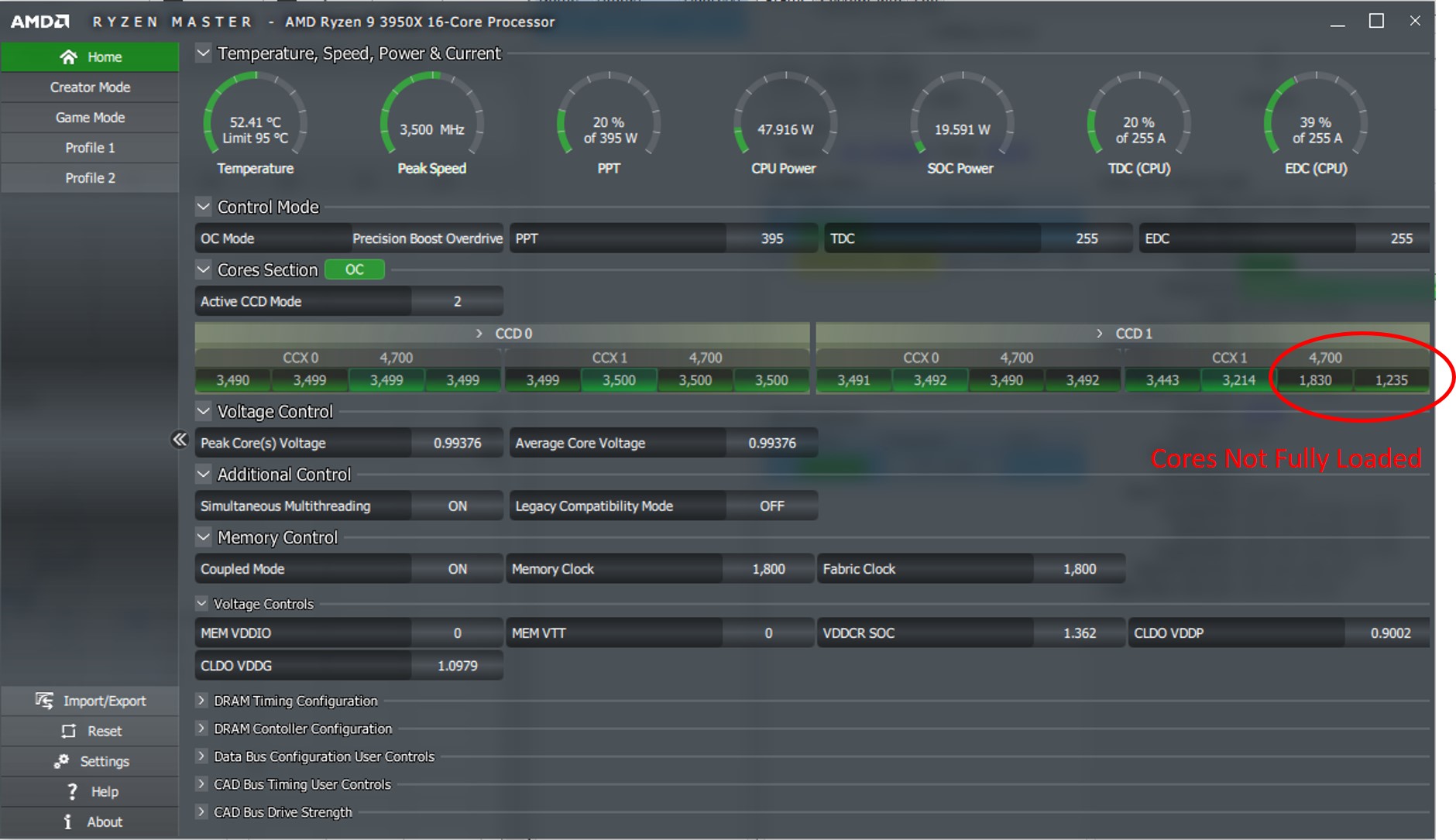
Some of you might be wondering why the performance and efficiency drops off when the thread count is set to the actual number of cores (16) or higher. I was too, so I re-ran some tests and looked at what was happening with AMD’s built-in Ryzen Master tool. As you can see in the screen shot below, even though the # of threads was set to 18 in Folding@Home (a number greater than the 16 physical cores), not all 16 cores were fully engaged on the processor. In fact, only 14 were clocked up, and two were showing relatively lazy clock rates.

Two Cores are Lazy!

Folding@Home 18-Thread CPU Solve on 16-Core Processor

I suspect what is happening is that some of the threads were loaded onto “virtual” CPU cores (i.e. SMT / hyper threading). This might be something Windows 10 does to preserve a few free CPU cores for other tasks. In fact, I didn’t see all of the cores turbo up to full speed until I set Folding@Home’s thread count to 24. This incidentally is when performance starts coming back in on the plots above.

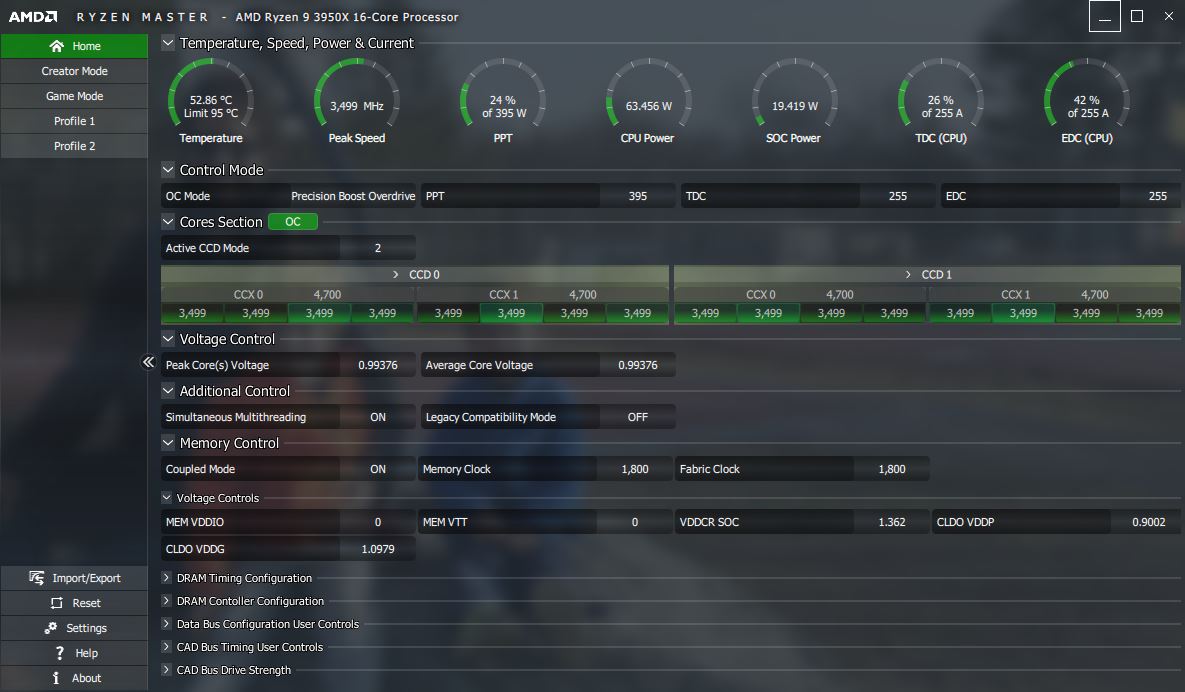
This weird SMT / Hyper-threading behavior is likely what is responsible for the large drop-off / flat part of the performance and efficiency curves that exists from thread count = 16 to 23. As you can see in the picture below, once you fully load all the available threads, the CPU frequencies on each core all hit the maximum value, as expected.

Ryzen_Master_32_Thread_Solve

Folding@Home 32-Thread CPU Solve on 16-Core Processor

Results Comparison

The following plots compare overall performance, power consumption, and efficiency of my new AMD Ryzen 9 3950x Folding@Home rig to other hardware configurations I have tested so far.

Performance

As you can see from the plot below, the Ryzen 9 3950x running a 32-thread Folding@Home solve can compete with relatively modern graphics cards in terms of raw performance. High-end GPUs will still offer more performance, but for a processor, getting over 400K PPD is very impressive. This is significantly more PPD than the previous processors I have tested (AMD Bulldozer-based FX-8320e, AMD Phenom II X6 1100t, Intel Core2Quad Q6600, etc). Admittedly I have not tested very many CPUs, since this is much more involved than just swapping out graphics cards to test.

AMD Ryzen 9 3950x Performance

Power Consumption

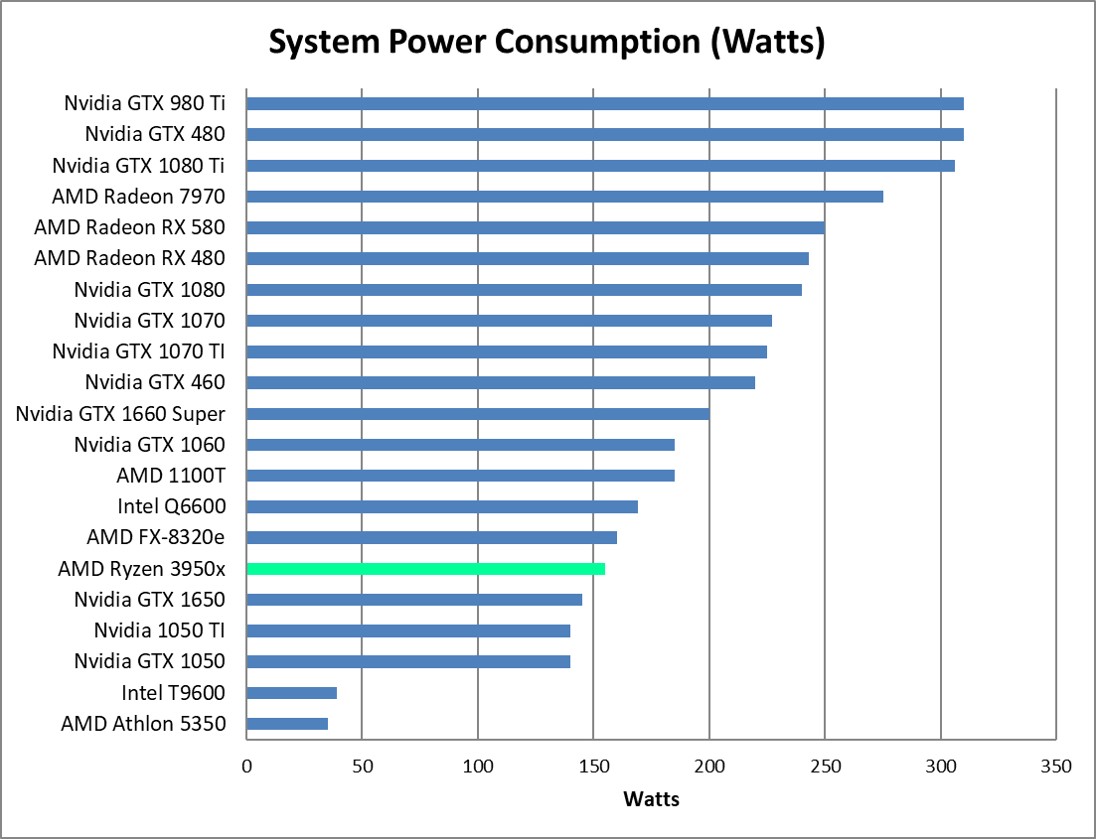
From a total system power consumption standpoint, my new benchmark machine with the AMD Ryzen 9 3950x has a surprisingly low total power draw when running Folding. Another interesting point is that since the 3950x lacks onboard graphics, I had to have a graphics card installed to get display. In my case, I had the Nvidia GTX 1650 installed, since this is a relatively low power consumption card that should provide minimal overhead. As you can see below, folding on the 3950x CPU (with the 1650 GPU idle) uses nearly the same amount of power as folding on the 1650 GPU (with the 3950x idle).

AMD Ryzen 9 3950x Power Consumption

Efficiency

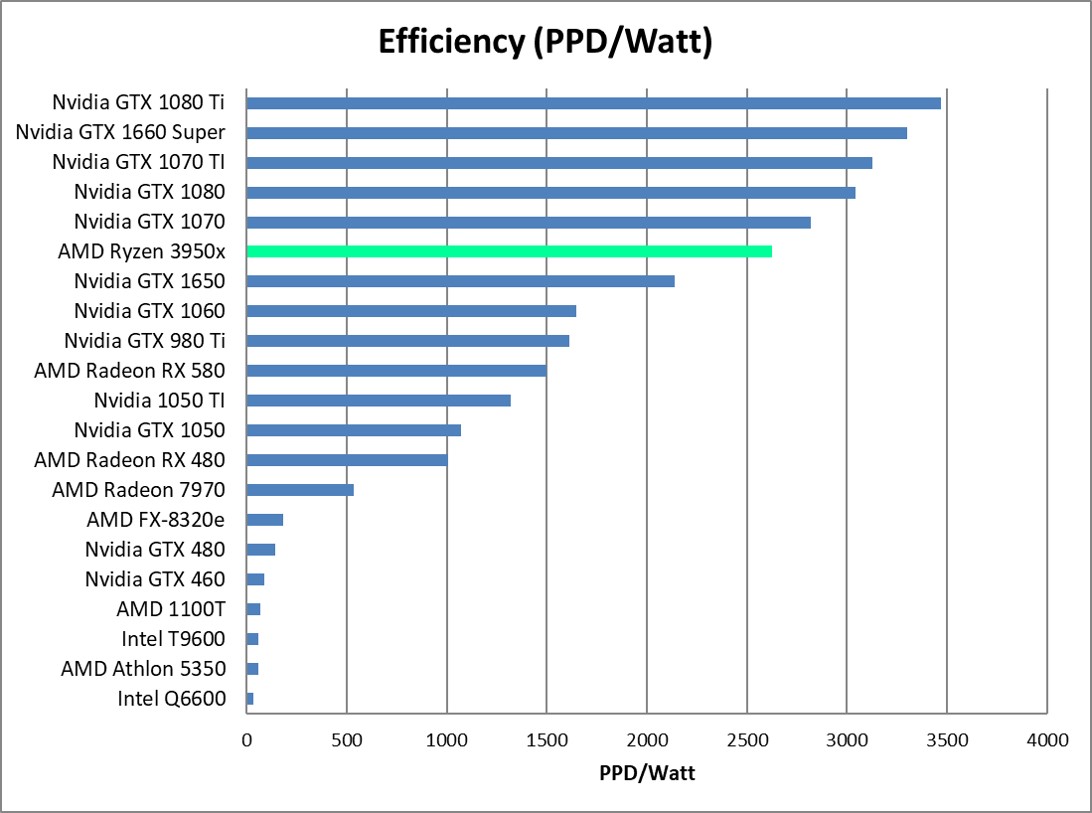
Efficiency is the point of this blog, and in this respect the 3950x comes in towards the upper middle of the pack of hardware configurations I have tested. It’s definitely the most efficient processor I have tested so far, but graphics cards such as the 1660 Super and 1080 Ti are more efficient. Despite drawing more total power from the wall, these high-end GPUs do a lot more science.

Still, a PPD/Watt of over 2500 is not bad, and in this case the 3950x is more efficient than folding on the modest GPU installed in the same box (the Nvidia GTX 1650). Compared to the much older AMD FX-8320e, the Ryxen 9 3950x is 14x more efficient! What a difference 7 years can make!

AMD Ryzen 9 3950x Efficiency

Conclusion

The 16-core, 32-thread AMD Ryzen 9 3950x is one fast processor, and can do a lot of science for the Folding@Home distributed computing project. Although mid to high-end graphics cards such as the 1080 Ti ($450 on the used market) can outperform the $700 3950x in terms of performance and efficiency, it is still important to have a smattering of high-end CPU folding rigs on the Folding@Home network, because some molecules can only be solved on CPUs.

There is a general trend of increasing efficiency and performance as the # of CPU threads allocated to Folding@Home increases. For the Ryzen 9 3950x, using a setting of 30 or 32 threads is recommended for maximum performance and efficiency. If you plan on using your computer for other tasks, or for simultaneously folding on the GPU, 30 threads is the ideal CPU slot setting.

Please Support My Blog!

If you are interested in measuring the power consumption of your own computer (or any device), please consider purchasing a P3 Kill A Watt Power Meter from Amazon. You’ll be surprised what a $35 investment in a watt meter can tell you about your home’s power usage, and if you make a few changes based on what you learn you will save money every year! Using this link won’t cost you anything extra, but will provide me with a small percentage of the sale to support the site hosting fees of GreenFolding@Home.

If you enjoyed this article, perhaps you are in the market for an AMD Ryzen 9 3950x or similar Ryzen processor. If so, please consider using one of the links below to buy one from Amazon. Thanks for reading!

AMD Ryzen 9 3950x Direct Link

AMD Ryzen (Amazon Search)

Future Work

In the next article, I’ll disable multithreading (SMT) to see the effect of virtualized CPU cores on Folding@Home performance.

Later, I plan to enable core performance boost on the 3950x to see what effect the automatic clock frequency and voltage overclocking has on Folding@Home performance and efficiency.


Folding@Home Review: NVIDIA GeForce GTX 1080 Ti

Released in March 2017, Nvidia’s GeForce GTX 1080 Ti was the top-tier card of the Pascal line-up. This is the graphics card that super-nerds and gamers drooled over. With an MSRP of $699 for the base model, board partners such as EVGA, Asus, Gigabyte, MSI, and Zotac (among others) all quickly jumped on board (pun intended) with custom designs costing well over the MSRP, as well as their own takes on the reference design.

GTX 1080 Ti Reference EVGA

EVGA GeForce GTX 1080 Ti – Reference

Three years later, with the release of the RTX 2080 Ti, the 1080 Ti still holds its own, and still commands well over $400 on the used market. These are beastly cards, capable of running most games with max settings in 4K resolutions.

But, how does it fold?

Folding@Home

Folding at home is a distributed computing project originally developed by Stanford University, where everyday users can lend their PC’s computational horsepower to help disease researchers understand and fight things like cancer, Alzheimer’s, and most recently the COVID-19 Coronavirus. User’s computers solve molecular dynamics problems in the background, which help the Folding@Home Consortium understand how proteins “misfold” to cause disease. For computer nerds, this is an awesome way to give (money–>electricity–>computer work–>fighting disease).

Folding at home (or F@H) can be run on both CPUs and GPUs. CPUs provide a good baseline of performance, and certain molecular simulations can only be done here. However, GPUs, with their massively parallel shader cores, can do certain types of single-precision math much faster than CPUs. GPUs provide the majority of the computational performance of F@H.

Geforce GTX 1080 Ti Specs

The 1080 Ti is at the top of Nvidia’s lineup of their 10-series cards.

1080 Ti Specs

With 3584 CUDA Cores, the 1080 Ti is an absolute beast. In benchmarks, it holds its own against the much newer RTX cards, besting even the RTX 2080 and matching the RTX 2080 Super. Only the RTX 2080 Ti is decidedly faster.

Folding@Home Testing

Testing is performed in my old but trusty benchmark machine, running Windows 10 Pro and using Stanford’s V7 Client. The Nvidia graphics driver version was 441.87. Power consumption measurements are taken on the system-level using a P3 Watt Meter at the wall.

System Specs:

  • CPU: AMD FX-8320e
  • Mainboard : Gigabyte GA-880GMA-USB3
  • GPU: EVGA 1080 Ti (Reference Design)
  • Ram: 16 GB DDR3L (low voltage)
  • Power Supply: Seasonic X-650 80+ Gold
  • Drives: 1x SSD, 2 x 7200 RPM HDDs, Blu-Ray Burner
  • Fans: 1x CPU, 2 x 120 mm intake, 1 x 120 mm exhaust, 1 x 80 mm exhaust
  • OS: Win10 64 bit

I did extensive testing of the 1080 Ti over many weeks. Folding@Home rewards donors with “Points” for their contributions, based on how much science is done and how quickly it is returned. A typical performance metric is “Points per Day” (PPD). Here, I have averaged my Points Per Day results out over many work units to provide a consistent number. Note that any given work unit can produce more or less PPD than the average, with variation of 10% being very common. For example, here are five screen shots of the client, showing five different instantaneous PPD values for the 1080 Ti.


GTX 1080 Ti Folding@Home Performance

The following plot shows just how fast the 1080 Ti is compared to other graphics cards I have tested. As you can see, with nearly 1.1 Million PPD, this card does a lot of science.

1080 Ti Folding Performance

GTX 1080 Ti Power Consumption

With a board power rating of 250 Watts, this is a power hungry graphics card. Thus, it isn’t surprising to see that power consumption is at the top of the pack.

1080 Ti Folding Power

GTX 1080 Ti Efficiency

Power consumption alone isn’t the whole story. Being a blog about doing the most work possible for the least amount of power, I am all about finding Folding@Home hardware that is highly efficient. Here, efficiency is defined as Performance Out / Power In. So, for F@H, it is PPD/Watt. The best F@H hardware is gear that maximizes disease research (performance) done per watt of power consumed.

Here’s the efficiency plot.

1080 Ti Folding Efficiency

Conclusion

The Geforce GTX 1080 Ti is the fastest and most efficient graphics card that I’ve tested so far for Stanford’s Folding@Home distributed computing project. With a raw performance of nearly 1.1 Million PPD in windows and an efficiency of almost 3500 PPD/Watt, this card is a good choice for doing science effectively.

Stay tuned to see how Nvidia’s latest Turing architecture stacks up.

GTX 460 Graphics Card Review: Is Folding on Ancient Hardware Worth It?

Recently, I picked up an old Core 2 duo build on Ebay for $25 + shipping. It was missing some pieces (Graphics card, drives, etc), but it was a good deal, especially for the all-metal Antec P182 case and included Corsair PSU + Antec 3-speed case fans. So, I figured what the heck, let’s see if this vintage rig can fold!

Antec 775 Purchase

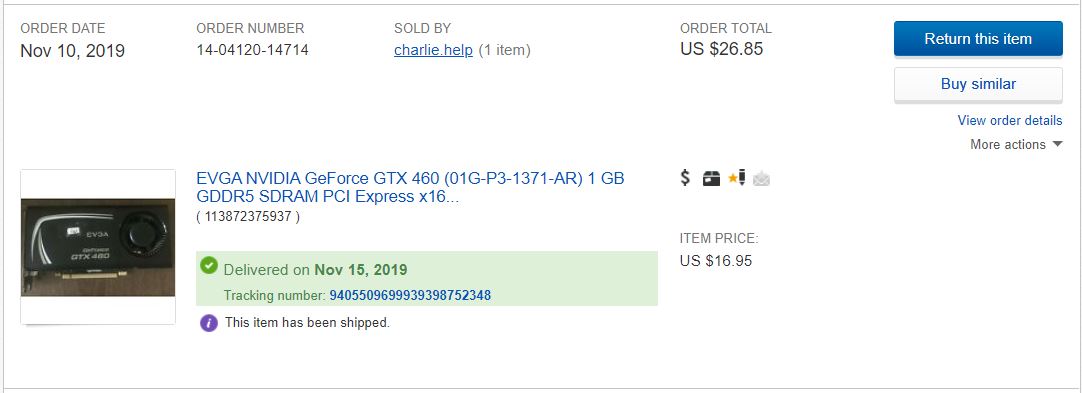
To complement this old Socket 775 build, I picked up a well loved EVGA GeForce GTX 460 on eBay for a grand total of $26.85. It should be noted that this generation of Nvidia graphics cards (based on the Fermi architecture from back in 2010) is the oldest GPU hardware that is still supported by Stanford. It will be interesting to see how much science one of these old cards can do.

GTX 460 Purchase

I supplied a dusty Western Digital 640 Black Hard Drive that I had kicking around, along with a TP Link USB wireless adapter (about $7 on Amazon). The Operating System was free (go Linux!). So, for under $100 I had this setup:

  • Case: Antec P182 Steel ATX
  • PSU: Corsair HX 520
  • Processor: Intel Core2duo E8300
  • Motherboard: EVGA nForce 680i SLI
  • Ram: 2 x 2 GB DDR2 6400 (800 MHz)
  • HDD: Western Digital Black 640GB
  • GPU: EVGA GeForce GTX 460
  • Operating System: Ubuntu Linux 18.04
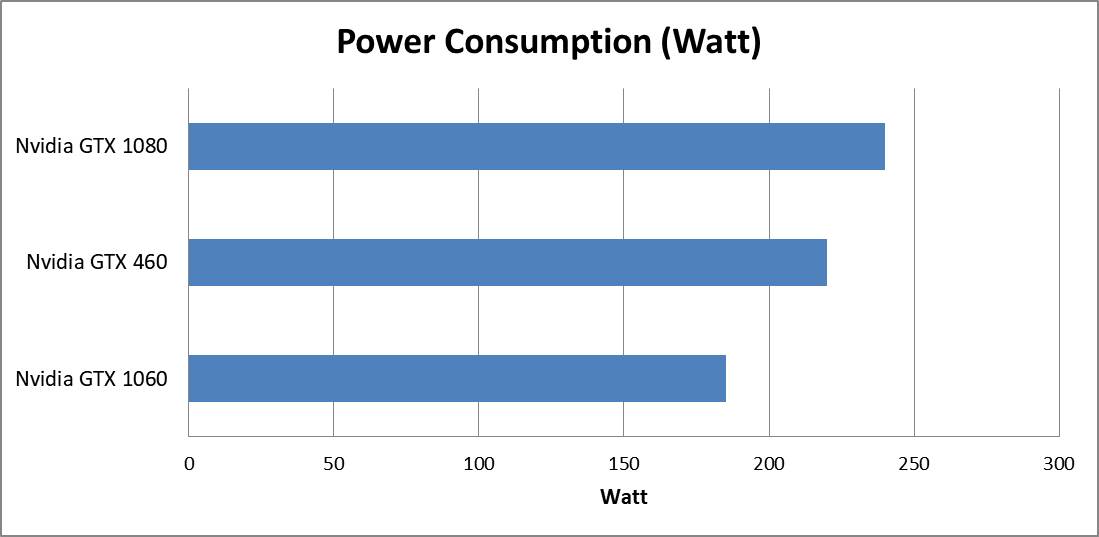
  • Folding@Home Client: V7

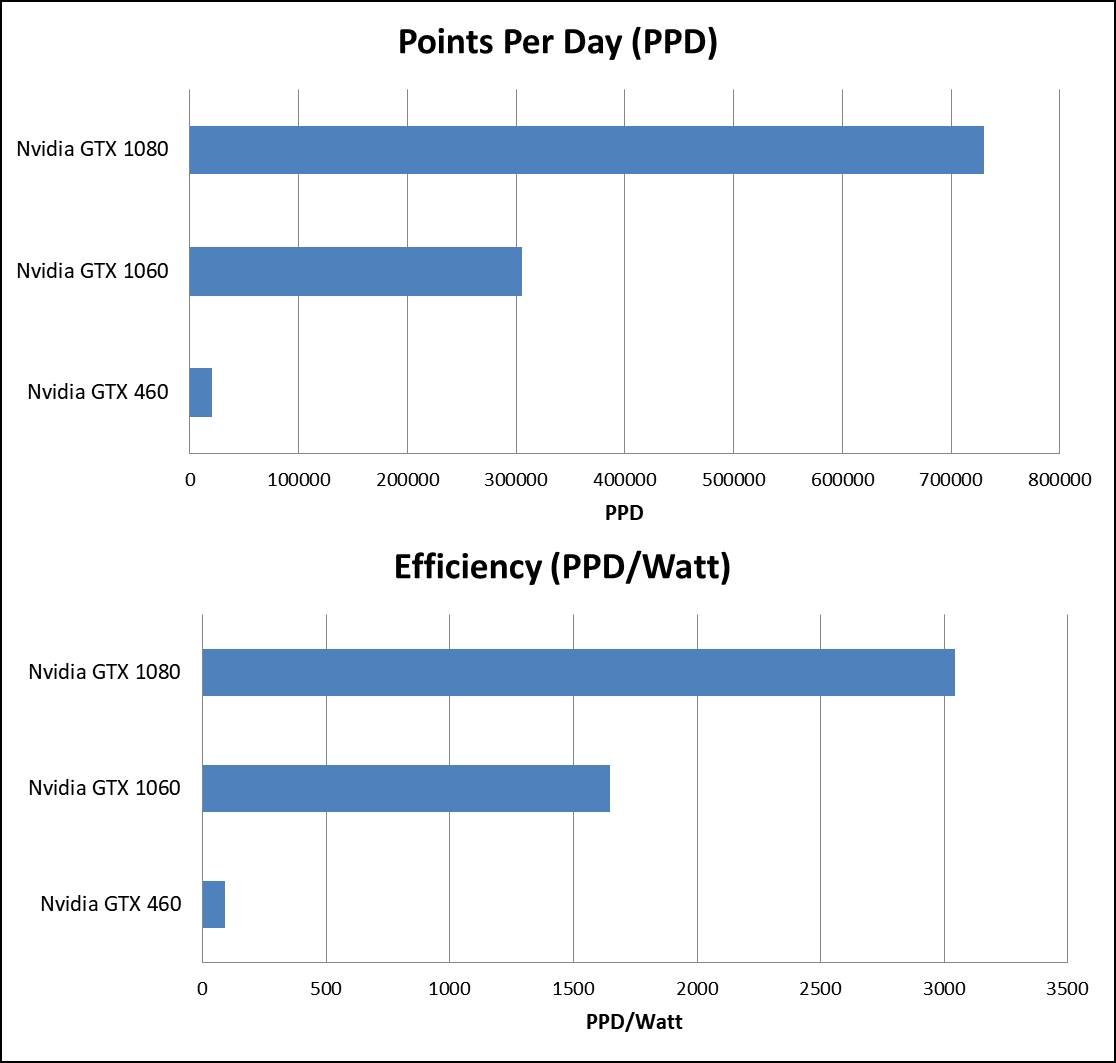
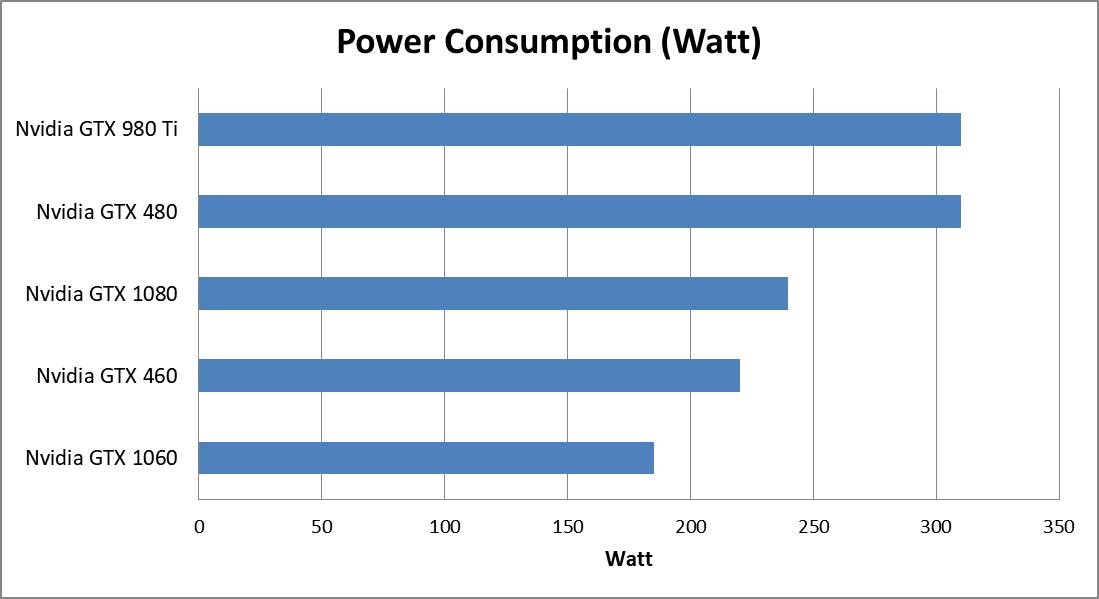
I fired up folding, and after some fiddling I got it running nice and stable. The first thing I noticed was that the power draw was higher than I had expected. Measured at the wall, this vintage folding rig was consuming a whopping 220 Watts! That’s a good deal more than the 185 watts that my main computer draws when folding on a modern GTX 1060. Some of this is due to differences in hardware configuration between the two boxes, but one thing to note is that the older GTX 460 has a TDP of 160 watts, whereas the GTX 1060 has a TDP of only 120 Watts.

Here’s a quick comparison of the GTX 460 vs the GTX 1060. At the time of their release, both of these cards were Nvidia’s baseline GTX model, offering serious gaming performance for a better price than the more aggressive GTX -70 and -80-series variants. I threw a GTX 1080 into the table for good measure.

GTX 460 Spec Comparison

GTX 460 Specification Comparison

The key takeaways here are that six years later, the equivalent graphics card to the GTX 460 was over three and a half times faster while using forty watts less power.

Power Consumption

I typically don’t report power consumption directly, because I’m more interested in optimizing efficiency (doing more work for less power). However, in this case, there is an interesting point to be made by looking at the wattage numbers directly. Namely, the GTX 460 (a mid-range card) uses almost as much power as a modern high-end GTX 1080, and uses seriously more power than the modern GTX 1060 mid-range card. Note: these power consumption numbers must be taken with a grain of salt, because the GTX 460 was installed in a different host system (the Core2 Duo rig) as the other cards, but the resutls are still telling. This is also consistent with the advertised TDP of the GTX 460, which is 40 watts higher than the GTX 1060.

GTX 460 Power Consumption (Wall)

Total System Power Consumption

Folding@Home Results

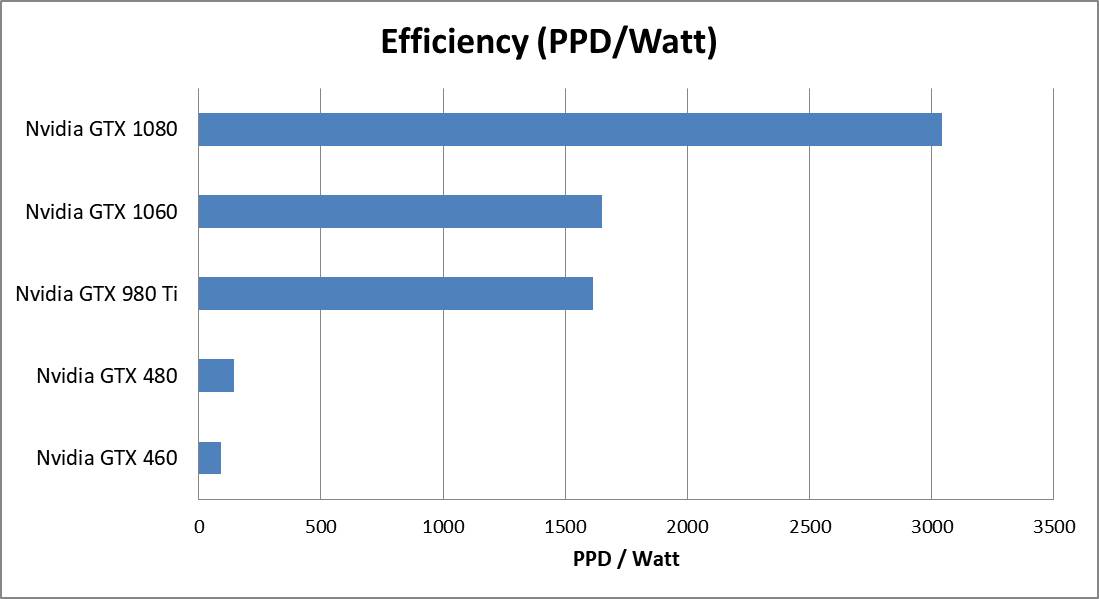
Folding on the old GTX 460 produced a rough average of 20,000 points per day, with the normal +/- 10% variation in production seen between work units. Back in 2006 when I was making a few hundred PPD on an old Athlon 64 X2 CPU, this would have been a huge amount of points! Nowadays, this is not so impressive. As I mentioned before, the power consumption at the wall for this system was 220 Watts. This yields an efficiency of 20,000 PPD / 220 Watts = 90 PPD/Watt.

Based off the relative performance, one would think the six-year newer GTX 1060 would produce somewhere between 3 and 4 times as many PPD as the older 460 card. This would mean roughly 60-80K PPD. However, my GTX 1060 frequently produces over 300K PPD. This is due to Stanford’s Quick Return Bonus, which essentially rewards donors for doing science quickly. You can read more about this incentive-based points system at Stanford’s website. The gist is, the faster you return a work unit to the scientists, the sooner they can get to developing cures for diseases. Thus, they award you more points for fast work. As the performance plot below shows, this quick return bonus really adds up, so that someone doing 3-4 times more (GTX 1060 vs. GTX 460 linear benchmark performance) results in 15 times more F@H performance.

GTX 460 Performance and Efficiency

Old vs. New Graphics Card Comparison: Folding@Home Efficiency and PPD

This being a blog about energy-conscious computing, I’d be remiss if I didn’t point out just how inefficient the ancient GTX 460 is compared to the newer cards. Due to the relatively high power consumption for a midrange card, the GTX 460 is eighteen times less efficient than the GTX 1060, and a whopping thirty three times less efficient than the GTX 1080.

Conclusion

Stanford eventually drops support for old hardware (anyone remember PS3 folding?), and it might not be long before they do the same for Fermi-based GPUs. Compared with relatively modern GPUs, the GTX 460 just doesn’t stack up in 2020. Now that the 10-series cards are almost four years old, you can often get GTX 1060s for less than $200 on eBay, so if you can afford to build a folding rig around one of these cards, it will be 18 times more efficient and make 15 times more points.

Still, I only paid about $100 total to build this vintage folding@home rig for this experiment. One could argue that putting old hardware to use like this keeps it out of landfills and still does some good work. Additionally, if you ignore bonus points and look at pure science done, the GTX 460 is “only” about 4 times slower than its modern equivalent.

Ultimately, for the sake of the environment, I can’t recommend folding on graphics cards that are many years out of date, unless you plan on using the machine as a space heater to offset heating costs in the winter. More on that later…

Addendum

Since doing the initial testing and outline for this article, I picked up a GTX 480 and a few GTX 980 Ti cards. Here are some updated plots showing these cards added to the mix. The GTX 480 was tested in the Core2 build, and the GTX 980 Ti in my standard benchmark rig (AMD FX-based Socket AM3 system).

Various GPU Power Consumption

GTX 980 and 480 Performance

GTX 980 and 480 Efficiency

I think the conclusion holds: even though the GTX 480 is slightly faster and more efficient than it’s little brother, it is still leaps and bounds worse than the more modern cards. The 980 Ti, being a top-tier card from a few generations back, holds its own nicely, and is almost as efficient as a GTX 1060. I’d say that the 980 Ti is still a relatively efficient card to use in 2020 if you can get one for cheap enough.

Is Folding@Home a Waste of Electricity?

Folding@home has brought together thousands of people (81 thousand active folders as of the time of this writing, as evidenced from Stanford’s One in a Million contributor drive.) This is awesome…tens of thousands of people teaming up to help researchers unravel the mysteries of terrible diseases.

But, there is a cost. If you are reading this blog, then you know the cost of scientific computing projects such as Folding@Home is environmental. In trying to save ourselves from the likes of cancer and Alzheimer’s disease, we are running a piece of software that causes our computers to use more electricity. In the case of dedicated folding@home computers, this can be hundreds of watts of power consumed 24/7. It adds up to a lot of consumed power, that in the end exits your computer as heat (potentially driving up your air conditioning costs as well).

Folding on Graphics Card Thermal

FLIR Thermal Cam – Folding@Home on Graphics Card

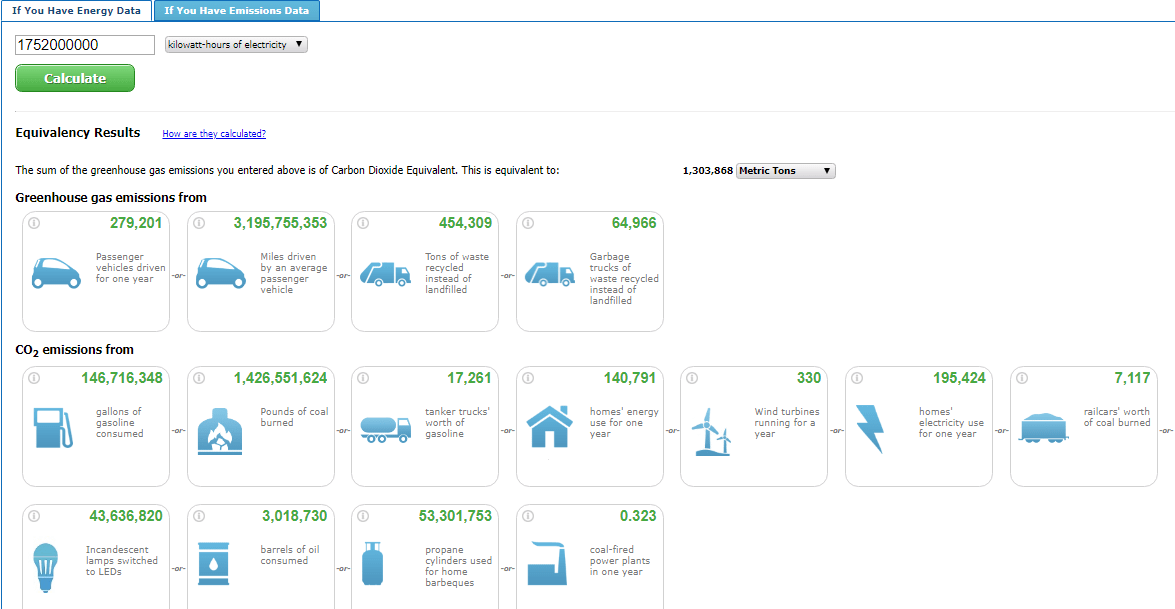
If Stanford reaches their goal of 1 million active folders, then we have an order of magnitude more power consumption on our hands. Let’s do some quick math, assuming each folder contributes 200 watts continuous (low compared to the power draw of most dedicated Folding@home machines). In this case, we have 200 watts/computer * 24 hours/day * 365 days/year * 1,000,000 computers *1 kilowatt-hour/1000 watt-hours = 1,752,000,000 kilowatt-hours of power consumed in a year, in the name of Science!

That’s almost two billion kilowatt-hours, people.  It’s 1.75 terawatt-hours (TWh)! Using the EPA’s free converter can put that into perspective. Basically, this is like driving 279 thousand extra cars for a year, or burning 1.5 billion pounds of coal.  Yikes!
https://www.epa.gov/energy/greenhouse-gas-equivalencies-calculator

F@H Energy Equivalence

Potential Folding@Home Environmental Impact

Is all this disease research really harming the planet? If it is, is it worth it? I don’t know. It depends on the outcome of the research, the potential benefit to humans, and the detriment to humans, animals, and the environment caused by that research. This opens up all sorts of what-if scenarios.

For example: what if Folding@Home does help find a future cure for many diseases, which results in extended life-spans. Then, the earth gets even more overpopulated than it is already. Wouldn’t the added environmental stresses negatively impact people’s health? Conversely, what if Folding@Home research results in a cure for a disease that allows a little girl or boy to grow to adulthood and become the inventor of some game-changing green technology?

It’s just not that easy to quantify.

Then, there is the topic of Folding@home vs. other distributed computing projects. Digital currency, for example. Bitcoin miners (and all the spinoffs) suck up a ton of power. Current estimates put Bitcoin alone at over 40 TWH a year.

Source: https://www.theguardian.com/technology/2018/jan/17/bitcoin-electricity-usage-huge-climate-cryptocurrency

That’s more power than some countries use, and twenty times more than my admittedly crude future Folding@home estimate. When you consider that the cryptocurrency product has only limited uses (many of which are on the darkweb for shady purposes), it perhaps helps cast Folding@home in a better light.

There is always room for improvement thought. That is the point of this entire blog. If we crazies are committed to turning our hard-earned dollars into “points”, we might as well do it in the most efficient way possible. And, while we’re at it, we should consider the environmental cost of our hobby and think of ways to offset it (that goes for the Bitcoin folks too).

I once ran across a rant on another online blog about how Folding@home is killing the planet. This was years ago, before the Rise of the Crypto. I wish I could find that now, but it seems to have been lost in the mists of time, long since indexed, ousted, and forgotten by the Google Search Crawler. In it, the author bemoaned over how F@H was murdering mother earth in the name of science. I recall thinking to myself, “hey, they’ve got a point”. And then I realized that I had already done a bunch of things to help combat the rising electric bill, and I bet most distributed computing participants have done some of these things too.

These things are covered elsewhere in this blog, and range from optimizing the computer doing the work to going after other non-folding@home related items to help offset the electrical and environmental cost. I started by switching to LED light-bulbs, then went to using space heaters instead of whole house heating methods in the winter. As I upgraded my Folding@home computer, I made it more energy efficient not just for F@H but for all tasks executed on that machine.

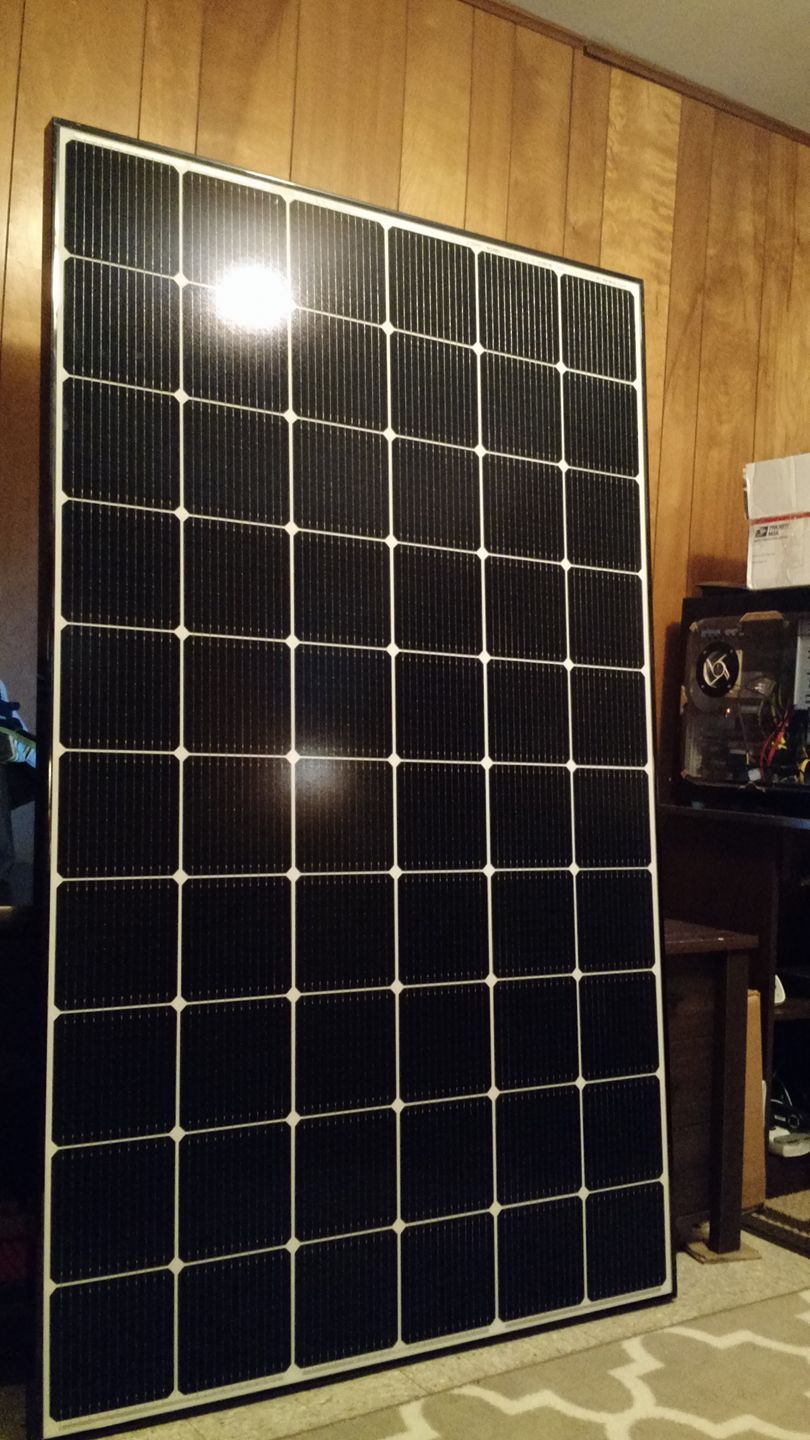
In the last two years, my wife and I bought a house, which gave us a whole other level of control over the situation. We had one of those state-subsidized energy audits done. They put in some insulation and air-sealed our attic, thus reducing our yearly heating costs. Eventually, we even decided to put solar panels on the roof and get an electric car (these last two weren’t because I felt guilty about running F@H, but because my wife and I are just into green technologies). We even use our Folding@home computer as a space heater in the winter, thus offsetting home heating oil use and negating any any environmental arguments against F@H in the winter months.

In conclusion, there is no doubt that distributed projects have an environmental cost. However, to claim that they are a waste of electricity or that they are killing the planet might be taking it too far. One has to ask if the cause is worth the environmental impact, and then figure out ways to lessen that impact (or in some cases get motivated to offset it completely. Solar powered folding farm, anyone?)

Solar Panel in Basement

LG 320 Solar Panel in my basement, awaiting roof install.

Folding on the NVidia GTX 1060

Overview

Folding@home is Stanford University’s charitable distributed computing project. It’s charitable because you can donate electricity, as converted into work through your home computer, to fight cancer, Alzheimer, and a host of other diseases.  It’s distributed, because anyone can run it with almost any desktop PC hardware.  But, not all hardware configurations are created equally.  If you’ve been following along, you know the point of this blog is to do the most work for as little power consumption as possible.  After all, electricity isn’t free, and killing the planet to cure cancer isn’t a very good trade-off.

Today we’re testing out Folding@home on EVGA’s single-fan version of the NVIDIA GTX 1060 graphics card.  This is an impressive little card in that it offers a lot of gaming performance in a small package.  This is a very popular graphics card for gamers who don’t want to spend $400+ on GTX 1070s and 1080s.  But, how well does it fold?

Card Specifications

Manufacturer:  EVGA
Model #:  06G-P4-6163
Model Name: EVGA GeForce GTX 1060 SC GAMING (Single Fan)
Max TDP: 120 Watts
Power:  1 x PCI Express 6-pin
GPU: 1280 CUDA Cores @ 1607 MHz (Boost Clock of 1835 MHz)
Memory: 6 GB GDDR5
Bus: PCI-Express X16 3.0
MSRP: $269

06G-P4-6163-KR_XL_4

EVGA Nvidia GeForce GTX 1060 (photo by EVGA)

Folding@Home Test Setup

For this test I used my normal desktop computer as the benchmark machine.  Testing was done using Stanford’s V7 client on Windows 7 64-bit running FAH Core 21 work units.  The video driver version used was 381.65.  All power consumption measurements were taken at the wall and are thus full system power consumption numbers.

If you’re interested in reading about the hardware configuration of my test rig, it is summarized in this post:

https://greenfoldingathome.com/2017/04/21/cpu-folding-revisited-amd-fx-8320e-8-core-cpu/

Information on my watt meter readings can be found here:

I Got a New Watt Meter!

FOLDING@HOME TEST RESULTS – 305K PPD AND 1650 PPD/WATT

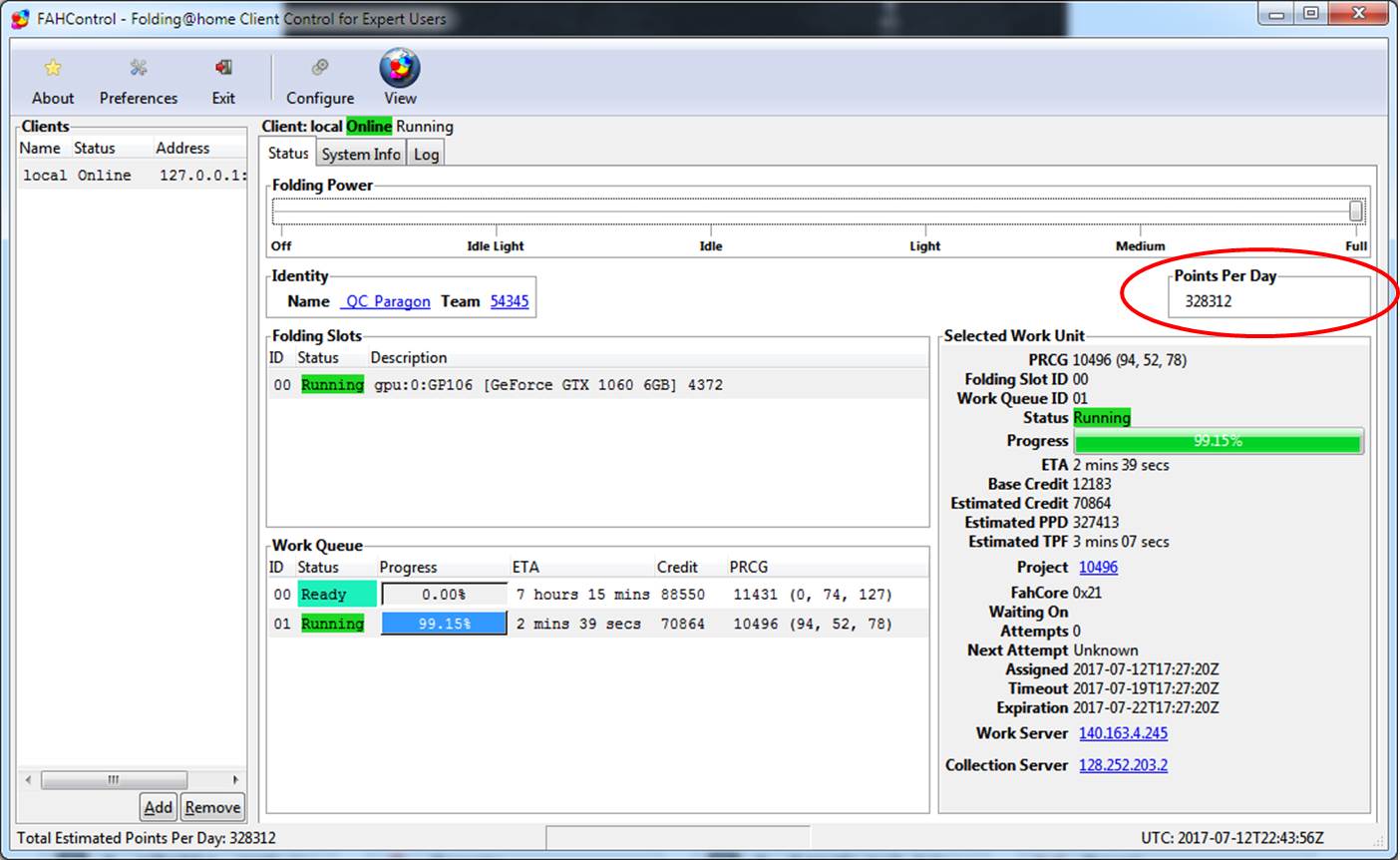
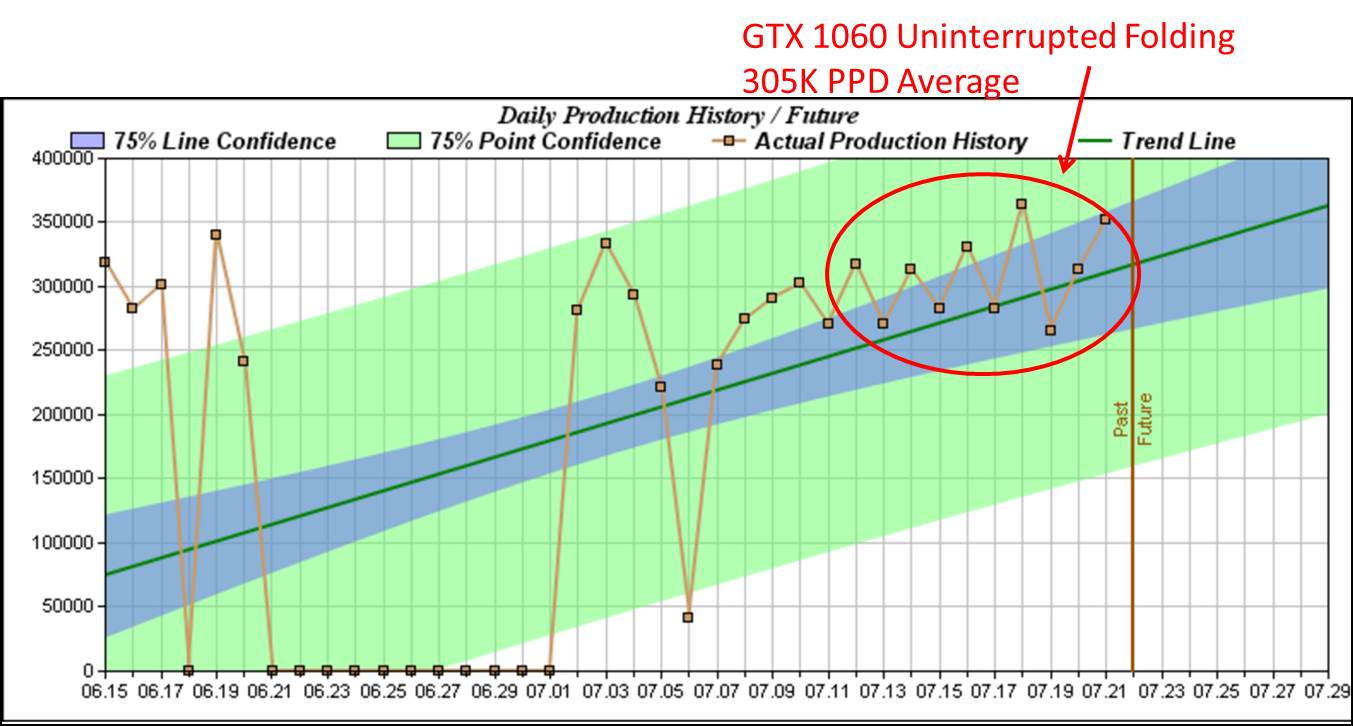
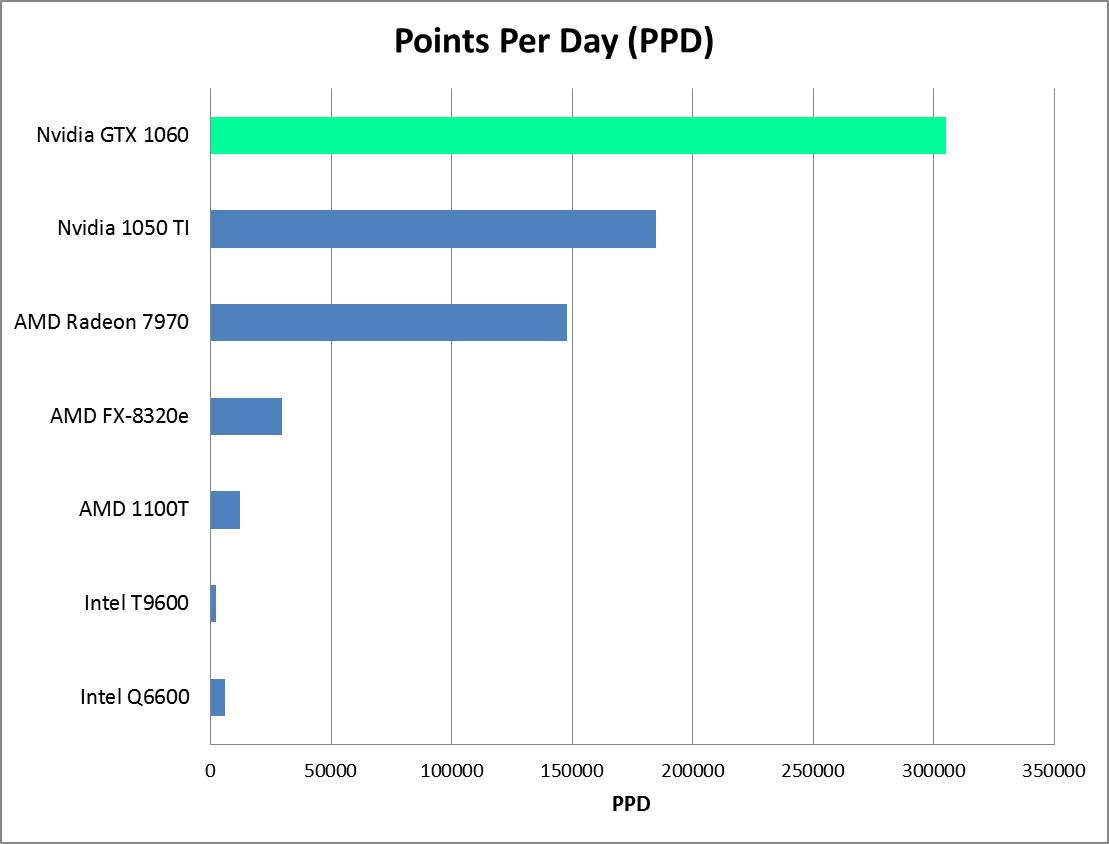
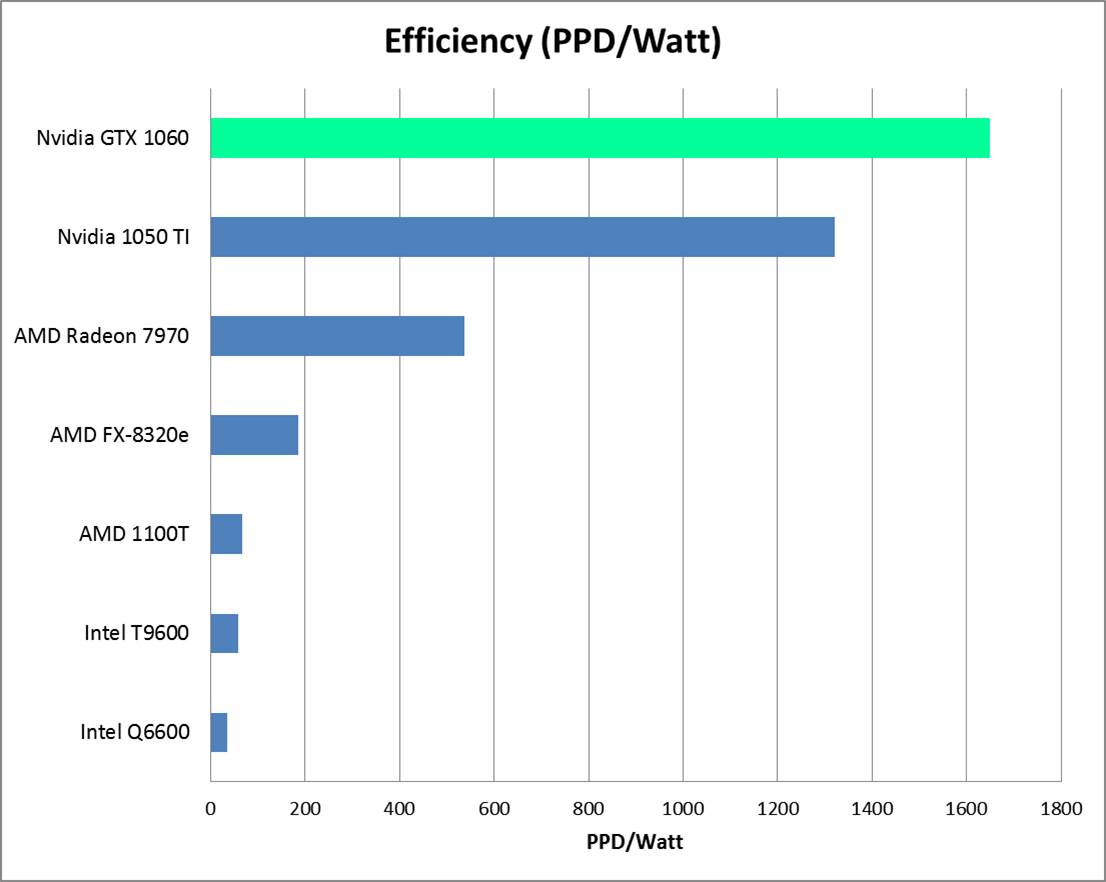
The Nvidia GTX 1060 delivers the best Folding@Home performance and efficiency of all the hardware I’ve tested so far.  As seen in the screen shot below, the native F@H client has shown up to 330K PPD.  I ran the card for over a week and averaged the results as reported to Stanford to come up with the nominal 305K Points Per Day number.  I’m going to use 305 K PPD in the charts in order to be conservative.  The power draw at the wall was 185 watts, which is very reasonable, especially considering this graphics card is in an 8-core gaming rig with 16 GB of ram.  This results in a F@H efficiency of about 1650 PPD/Watt, which is very good.

Screen Shot from F@H V7 Client showing Estimated Points per Day:

1060 TI Client

Nvidia GTX 1060 Folding @ Home Results: Windows V7 Client

Here are the averaged results based on actual returned work units

(Graph courtesy of http://folding.extremeoverclocking.com/)

1060 GTX PPD History

NVidia 1060 GTX Folding PPD History

Note that in this plot, the reported results previous to the circled region are also from the 1060, but I didn’t have it running all the time.  The 305K PPD average is generated only from the work units returned within the time frame of the red circle (7/12 thru 7/21)

Production and Efficiency Plots

Nvidia 1060 PPD

NVidia GTX 1060 Folding@Home PPD Production Graph

Nvidia 1060 PPD per Watt

Nvidia GTX 1060 Folding@Home Efficiency Graph

Conclusion

For about $250 bucks (or $180 used if you get lucky on eBay), you can do some serious disease research by running Stanford University’s Folding@Home distributed computing project on the Nvidia GTX 1060 graphics card.  This card is a good middle ground in terms of price (it is the entry-level in NVidia’s current generation of GTX series of gaming cards).  Stepping up to a 1070 or 1080 will likely continue the trend of increased energy efficiency and performance, but these cards cost between $400 and $800.  The GTX 1060 reviewed here was still very impressive, and I’ll also point out that it runs my old video games at absolute max settings (Skyrim, Need for Speed Rivals).  Being a relatively small video card, it easily fits in a mid-tower ATX computer case, and only requires one supplemental PCI-Express power connector.  Doing over 300K PPD on only 185 watts, this Folding@home setup is both efficient and fast. For 2017, the NVidia 1060 is an excellent bang-for-the-buck Folding@home Graphics Card.

Request: Anyone want to loan me a 1070 or 1080 to test?  I’ll return it fully functional (I promise!)

Folding@Home on the Nvidia GeForce GTX 1050 TI: Extended Testing

Hi again.  Last week, I looked at the performance and energy efficiency of using an Nvidia GeForce GTX 1050 TI to run Stanford’s charitable distributed computing project Folding@home.  The conclusion of that study was that the GTX 1050 TI offers very good Points Per Day (PPD) and PPD/Watt energy efficiency.  Now, after some more dedicated testing, I have a few more thoughts on this card.

Average Points Per Day

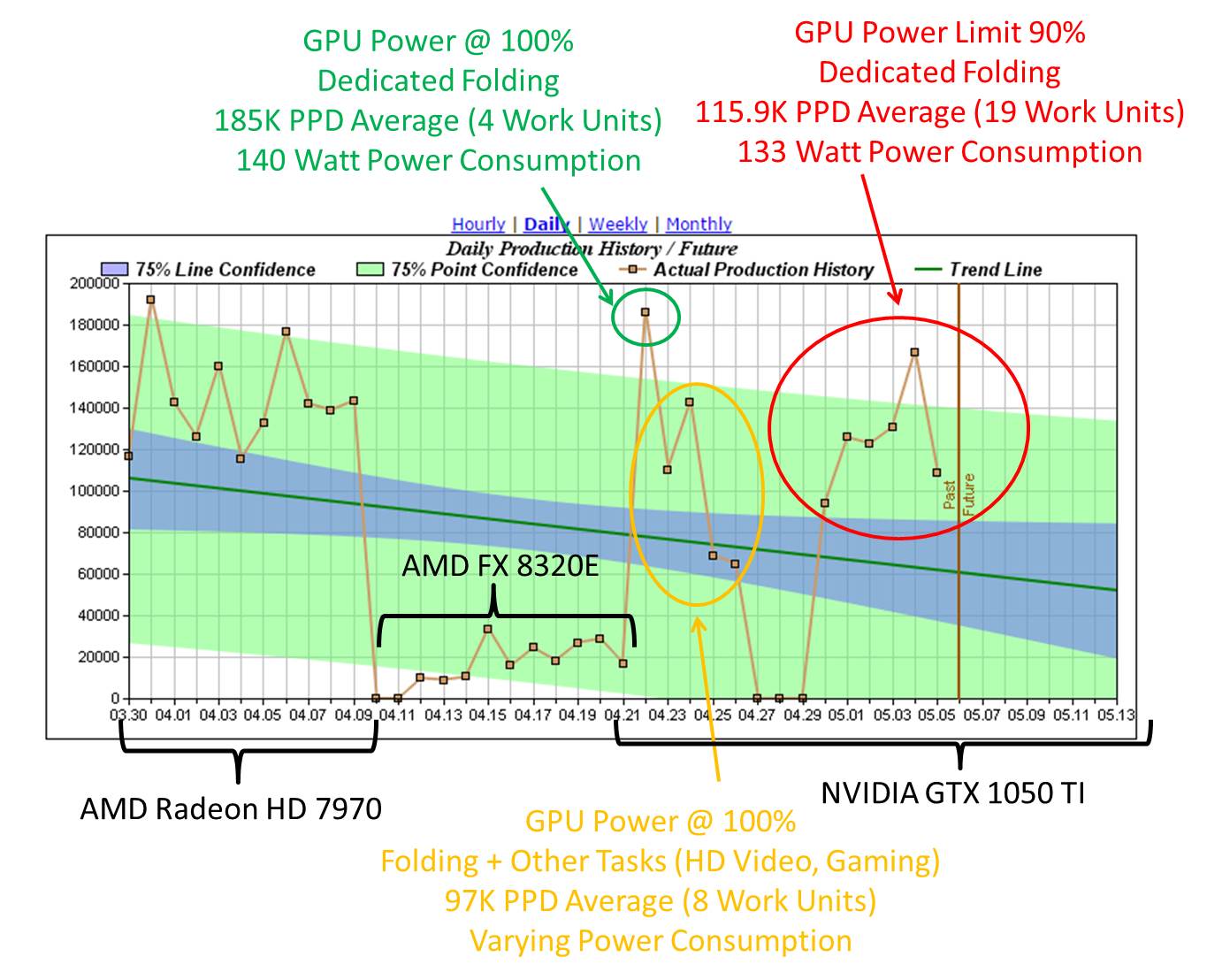
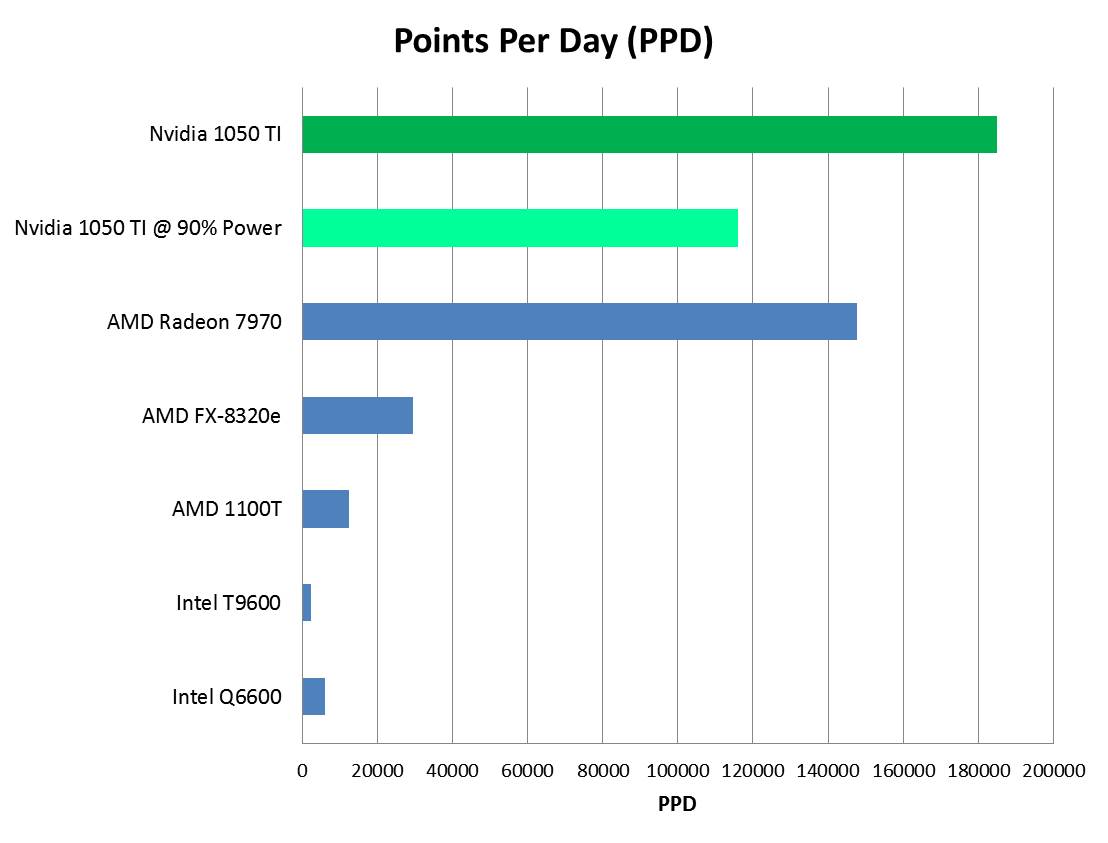
In the last article, I based the production and efficiency numbers on the estimated completion time of one work unit (Core 21), which resulted in a PPD of 192,000 and an efficiency of 1377 PPD/Watt.  To get a better number, I let the card complete four work units and report the results to Stanford’s collection server.  The end result was a real-world performance of 185K PPD and 1322 PPD/Watt (power consumption is unchanged at 140 watts @ the wall).  These are still very good numbers, and I’ve updated the charts accordingly.  It should be noted that this still only represents one day of folding, and I am suspicious that this PPD is still on the high end of what this card should produce as an average.  Thus, after this article is complete, I’ll be running some more work units to try and get a better average.

Folding While Doing Other Things

Unlike the AMD Radeon HD 7970 reviewed here, the Nvidia GTX 1050 TI doesn’t like folding while you do anything else on the machine.  To use the computer, we ended up pausing folding on multiple occasions to watch videos and browse the internet.  This results in a pretty big hit in the amount of disease-fighting science you can do, and it is evident in the PPD results.

Folding on a Reduced Power Setting

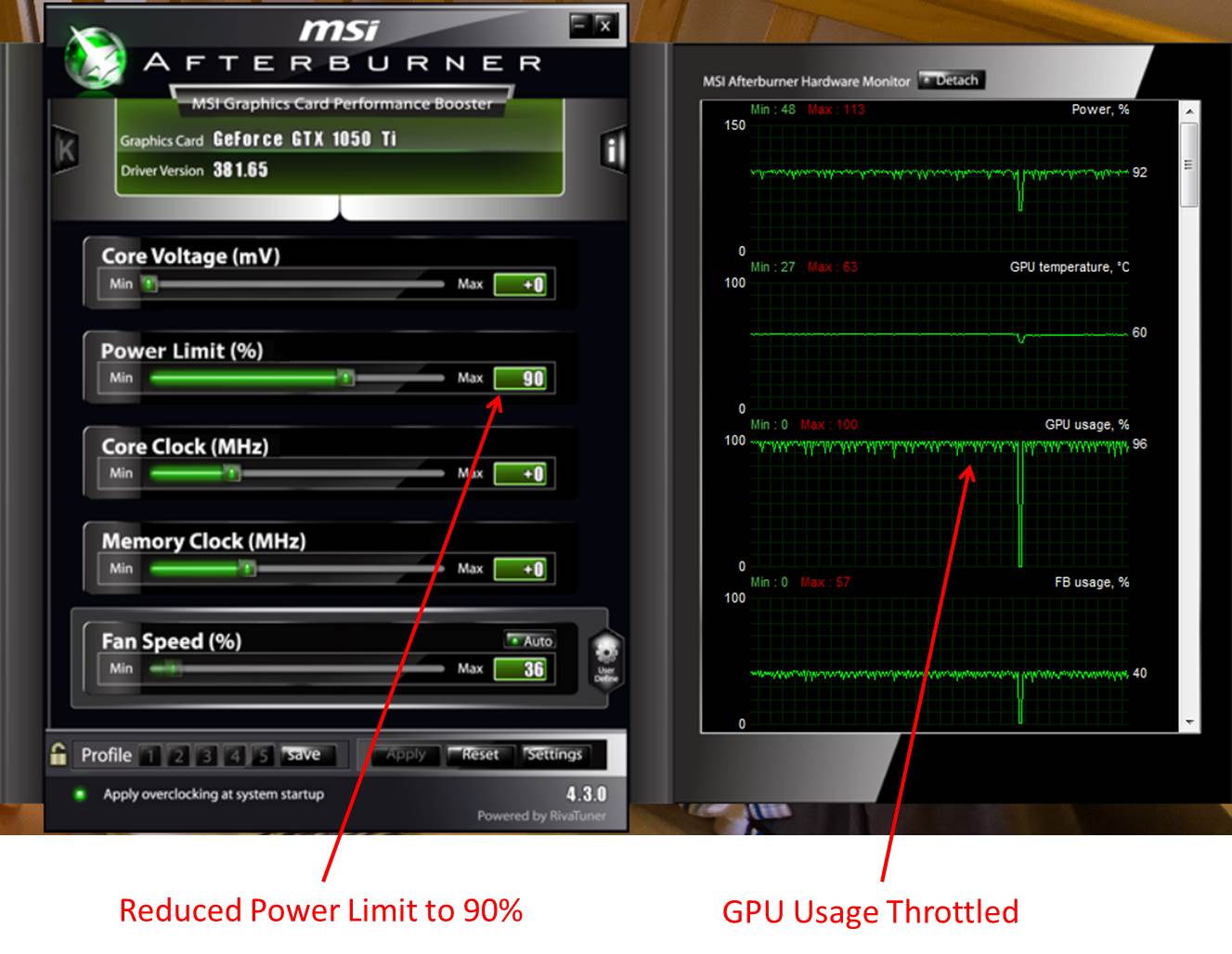
Finally, we went back to uninterrupted folding on the card, but at a reduced power setting (90%, set using MSI Afterburner).  This resulted in a 7 watt reduction of power consumption as measured at the wall (133 watts vs. 140 watts).  However, in order to produce this reduction in power, the graphics card’s clock speed is reduced, resulting in more than a performance hit.  The power settings can be seen here:

GTX 1050 Throttled

MSI Afterburner is used to reduce GPU Power Limit

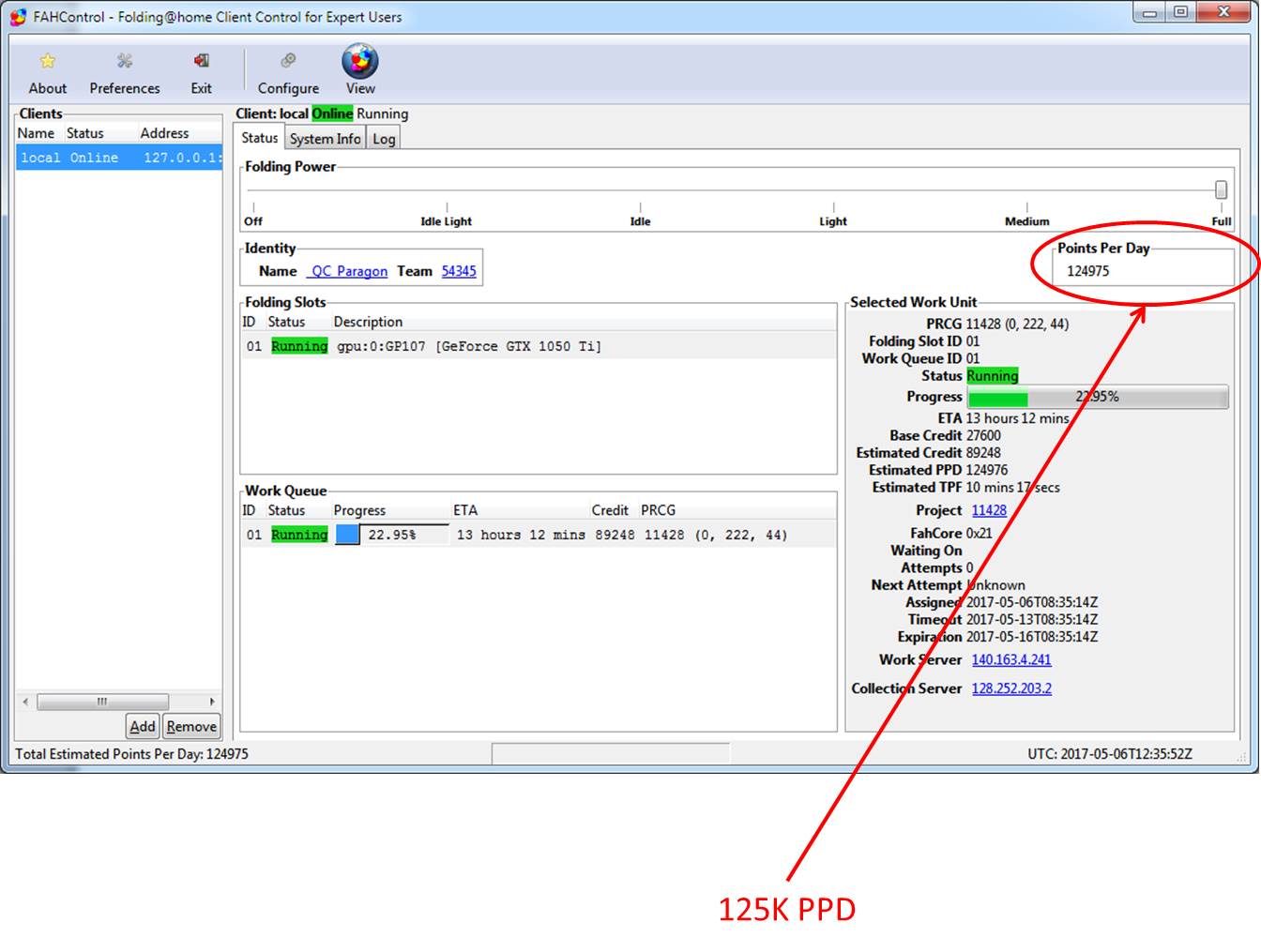
Observing the estimated Folding@home PPD in the Windows V7 client shows what appears to be a massive reduction in PPD compared to previous testing.  However, since production is highly dependent on the individual projects and work units, this reduction in PPD should be taken with a grain of salt.

GTX 1050 V7 Throttled Performance

In order to get some more accurate results at the reduced power limit, we let the machine chug along uninterrupted for a week.  Here is the PPD production graph courtesy of http://folding.extremeoverclocking.com/

GTX 1050 Extended Performance Testing

Nvidia GTX 1050 TI Folding@Home Extended Performance Testing

It appears here that the 90% power setting has caused a significant reduction in PPD. However, this is based on having only one day’s worth of results (4 work units) for the 100% power case, as opposed to 19 work units worth of data for the 90% power case. More testing at 100% power should provide a better comparison.

Updated Charts (pending further baseline testing)

GTX 1050 PPD Underpowered

Nvidia GTX 1050 PPD Chart

GTX 1050 Efficiency Underpowered

Nvidia GTX 1050 TI Efficiency

As expected, you can contribute the most to Stanford’s Folding@home scientific disease research with a dedicated computer.  Pausing F@H to do other tasks, even for short periods, significantly reduces performance and efficiency.  Initial results seem to indicate that reducing the power limit of the graphics card significantly hurts performance and efficiency.  However, there still isn’t enough data to provide a detailed comparison, since the initial PPD numbers I tested on the GTX 1050 were based on the results of only 4 completed work units.  Further testing should help characterize the difference.

Squeezing a few more PPD out of the FX-8320E

In the last post, the 8-core AMD FX-8320E was compared against the AMD Radeon 7970 in terms of both raw Folding@home computational performance and efficiency.  It lost, although it is the best processor I’ve tested so far.  It also turns out it is a very stable processor for overclocking.

Typical CPU overclocking focuses on raw performance only, and involves upping the clock frequency of the chip as well as the supplied voltage.  When tuning for efficiency, doing more work for the same (or less) power is what is desired.  In that frame of mind, I increased the clock rate of my FX-8320e without adjusting the voltage to try and find an improved efficiency point.

Overclocking Results

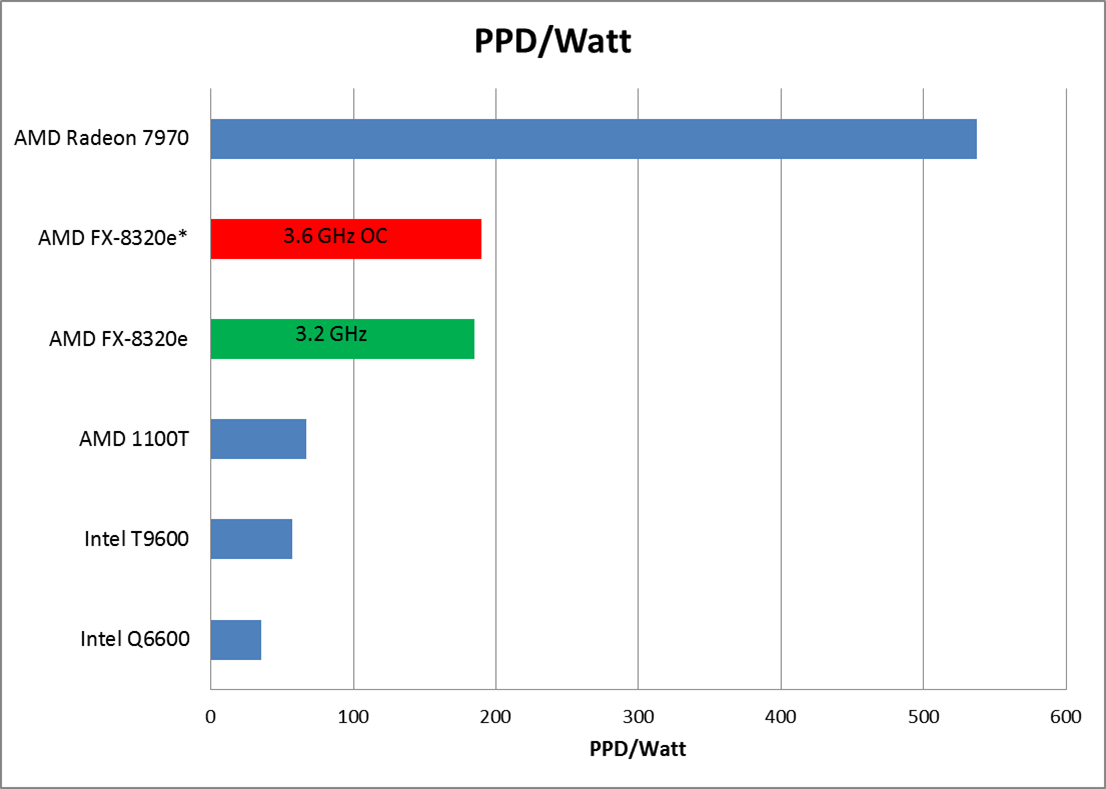
My FX-8320E proved to be very stable at stock voltage at frequencies up to 3.6 GHz.  By very stable, I mean running Folding@home at max load on all CPUs for over 24 hours with no crashes, while also using the computer for daily tasks.   This is a 400 MHz increase over the stock clock rate of 3.2 GHz.  As expected, F@H production went up a noticeable amount (over 3000 PPD).  Power consumption also increased slightly.  It turns out the efficiency was also slightly higher (190 PPD/watt vs. 185 PPD/watt).  So, overclocking was a success on all fronts.

FX 8320e overclock PPD

FX 8320e overclock efficiency

Folding Stats Table FX-8320e OC

Conclusion

As demonstrated with the AMD FX-8320e, mild overclocking can be a good way to earn more Points Per Day at a similar or greater efficiency than the stock clock rate.  Small tweaks like this to Folding@home systems, if applied everywhere, could result in more disease research being done more efficiently.